
Sixteenth Century
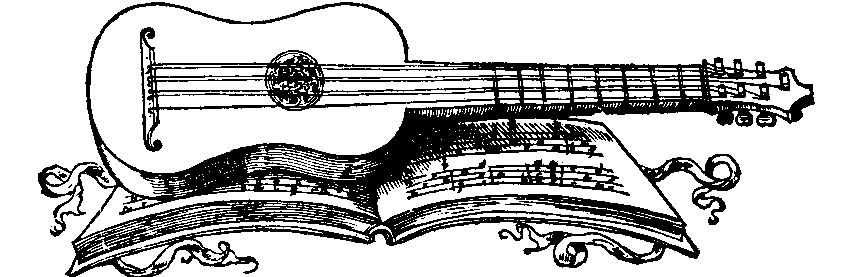
The Renaissance guitar was a fairly small instrument with only four courses (sets of strings, usually in pairs) that were tuned like the top four strings of a modern guitar. For a short time it was a very popular instrument and there was a number of books of guitar music published in the middle of the sixteenth century. The only one that references nails is Miguel de Fuenllana Orphenica Lyra (1554). Strictly speaking, it is not a guitar publication. Nearly all the works it contains are for vihuela (Spain’s equivalent of lute which was shaped rather like a guitar), but it does also contain a small handful of works for the Renaissance guitar. In the book, Fuenllana wrote that, ‘striking the course with an attack, without the intrusion of fingernail or another kind of device, demonstrates great excellence.’1 Moreover, the published music for the Renaissance guitar was mostly written by lutenists, who generally played without nails. It’s reasonable to assume that, at least among those playing this written music, the right-hand techniques were the same.

Seventeenth and Eighteenth Centuries
We first get direct references to nails with the five-course Baroque guitar. It was evidently played both with and without nails. Contemporary lute tutor books were usually against the use of nails, but the Baroque guitar’s repertoire was rather distinct from the lute’s — particularly because of its re-entrant tuning and use of strumming — and arguably suits nails particularly well. We know, for example, that the great Italian guitarist Francesco Corbetta (c. 1615-1681) played with nails, as we have a contemporary account of his having to cancel a concert because to a broken nail.2 There was also a number of Baroque guitarists who played the theorbo, for which there is evidence of nail use.3 The most explicit reference I have yet found was written in the late eighteenth-century and is against nails4 — but this was at the end period of the five-course guitar, when it had a different repertoire and cannot quite be considered the same instrument as its earlier Baroque incarnation.
The Birth of the Six-String Guitar
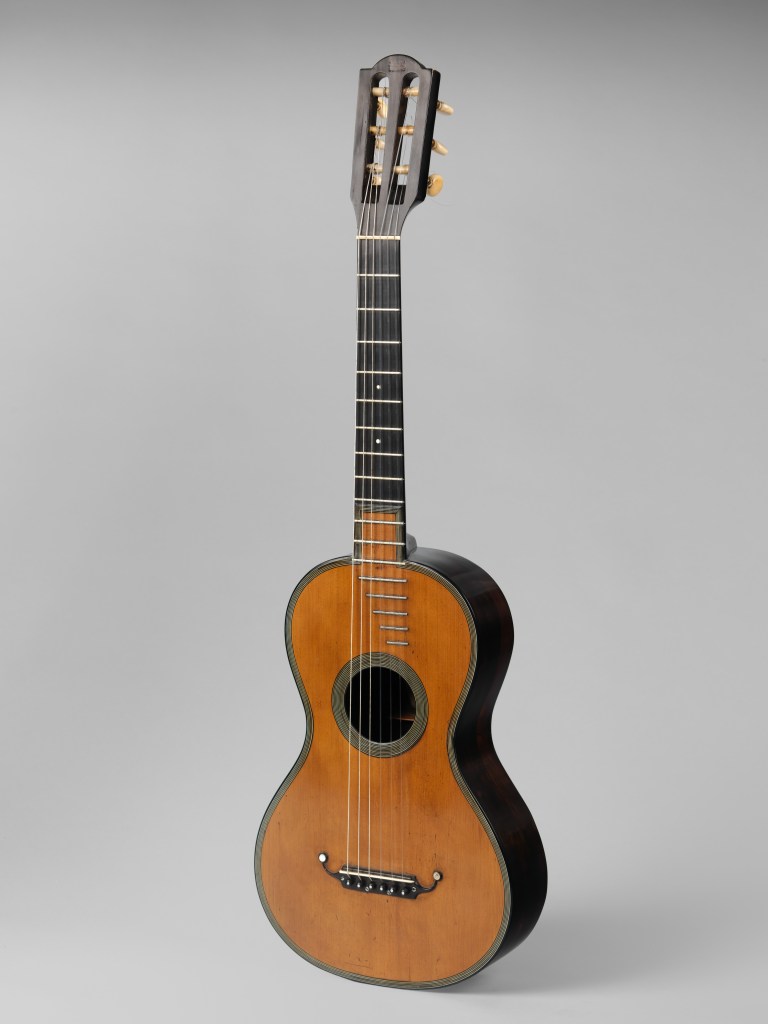
During the second half of the eighteenth century, the guitar gained a sixth string, the tuning changed to the one we still use today, and paired courses were replaced by single strings. Some regions took longer to arrive at this design than others, but by the early nineteenth century this new guitar became dominant in most of Europe.5 This was the beginning of the classical guitar as we know it today. When references to nails appear, it is usually in opposition to them. The most famous example may be Fernando Sor, who, in his influential 1830 Method, wrote emphatically that, ‘Never in my life have I heard a guitarist whose playing was supportable, if he played with the nails.’6 You can discover some of the other nineteenth-century no-nail guitarists on the Players page.
While the European and American mainstream was flesh playing, there was one country where nail playing was the preferred method, as early as the late eighteenth-century: Spain. Throughout the nineteenth century, most Spanish virtuosi played with nails, from Dionisio Aguado to José Ferrer. This is partly why Francisco Tárrega cutting off his nails at the beginning of the twentieth century was a surprising and controversial moment. It should be emphasised that what Tarrega was doing was not holding on to an old way of playing, but in fact breaking with the Spanish tradition into which he learnt the guitar. He was not seeking to re-establish a nineteenth-century no-nail technique, but rather discover a new way of striking the string.

Twentieth Century
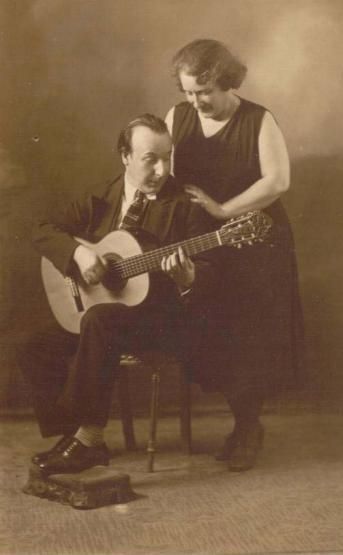
It is difficult to imagine what kind of role no-nail playing might have had in the twentieth century without Tárrega. With some notable exceptions, it was players that descended from the Tárrega school who kept no-nail playing alive. Most guitarists in the twentieth century instead decided to follow the examples of nail players such as Andrés Segovia and Luigi Mozzani. Indeed, some of Tárrega’s students did not follow his example and instead continued to play with nails, but many — possibly a majority — converted to flesh. Emilio Pujol, Josefina Robledo, Daniel Fortea and others became important performers and teachers who championed no-nail playing and whose influence was enormous. They in turn had a number of prominent no-nail students, such as Manuel Cubedo, Francisco Alfonso, and Jose Maria Sierra. The best no-nail players were playing concert halls, concerti, and making recordings.

Some readers may be surprised by just how long no-nail playing lasted in the twentieth century. Even in the late 1950s, for example, it was a hotly contested subject in several issues of a French guitar journal. In 1963, Otto Zykan remarked in a German guitar journal that, ‘Ten years ago, people were afraid to broach the sensitive subject [of nails and flesh]. It did not lead to a feud, but it still meant insulting the other side. … it was a bitter fight … primarily directed against the newer nail stroke.’7 There were even some no-nailers with successful concert careers into the 1990s, such as the Cuban guitarist Juan Mercadal. Indeed, no-nail playing never entirely died out, but players had become very few.
The Present Day
Despite this long and important history, for several decades it has been the consensus among classical guitarists that one must play with nails. This is starting to change. The internet has opened up access to many neglected historical resources and allowed a nascent community of no-nail players to develop. A key figure in the twenty-first century revival of no-nail playing is Rob MacKillop, whose YouTube channel and website were the reason so many players, including myself, became interested in the subject. There are now many excellent guitarists who play without nails, and the number only seems to be growing. To discover more, please do go over to the Players page.
As an addendum, I should briefly discuss the non-classical iterations of the guitar. In the twentieth-century, the guitar of course became a more varied family of instruments. Before, the classical guitar was simply the guitar everyone played — there wasn’t even a distinction between flamenco and classical instruments. Now we have classical, flamenco, steel-string acoustic, resonator, archtop, solid-body electric, and doubtless more that escape my mind. No-nail playing is more common on the non-nylon instruments — big names like Tommy Emmanuel play without nails, seemingly without controversy. With electrified instruments, nails or no-nails becomes a somewhat different question, however. Tone production and projection are not solely affected by the plucking device, but also by amplifiers and electronic effects. As I haven’t played these other types of guitar for many years, I don’t feel qualified to comment further. But I welcome comments and insights from those who play these guitars — please do get in touch.
- Miguel de Fuenllana, Orphénica Lyra, ed. Charles Jacobs (Oxford University Press, 1978), p. xci. ↩︎
- Aulus, Apronius (=Adam Ebert), Reise-Beschreibung von Villa Franca der ChurBrandenburg (Villa Franca, 1723), p. 251, referenced in Christopher Page, The Guitar in Stuart England (Cambridge University Press, 2017), p. 96. ↩︎
- A 1723 letter from Silvius Leopold Weiss indicates that the lute is usually played with the flesh, but the theorbo with the nail. And Thomas Mace (1676) suggests that nails ‘might do well enough’ when playing in ensembles, but he much prefers the mellowness of flesh when playing solo. He also indicates that many do play with nails, contrary to his preference. ↩︎
- See https://nonailguitar.com/players/barthelemy-trille-labarre-1758-1797/ ↩︎
- In Russia, a seven-string guitar tuned to G major developed instead, with a repertoire as impressive as its six-string counterpart. See https://sarenkoandco.com/ for more information. The wire-strung English guittar (really a cittern), also in an open major tuning, was also popular. Both the Russian and English guitars were plucked without nails. ↩︎
- Ferdinand Sor, Method for the Spanish Guitar, trans. A Merrick (De Capo Press, 1971), p. 17. ↩︎
- Otto Zykan, ‘Der Nagelandschlag’, 6 Saiten, 46.3 (1963), pp. 1-5 (p. 1). ↩︎
 No-Nail Guitar
Leave a comment