
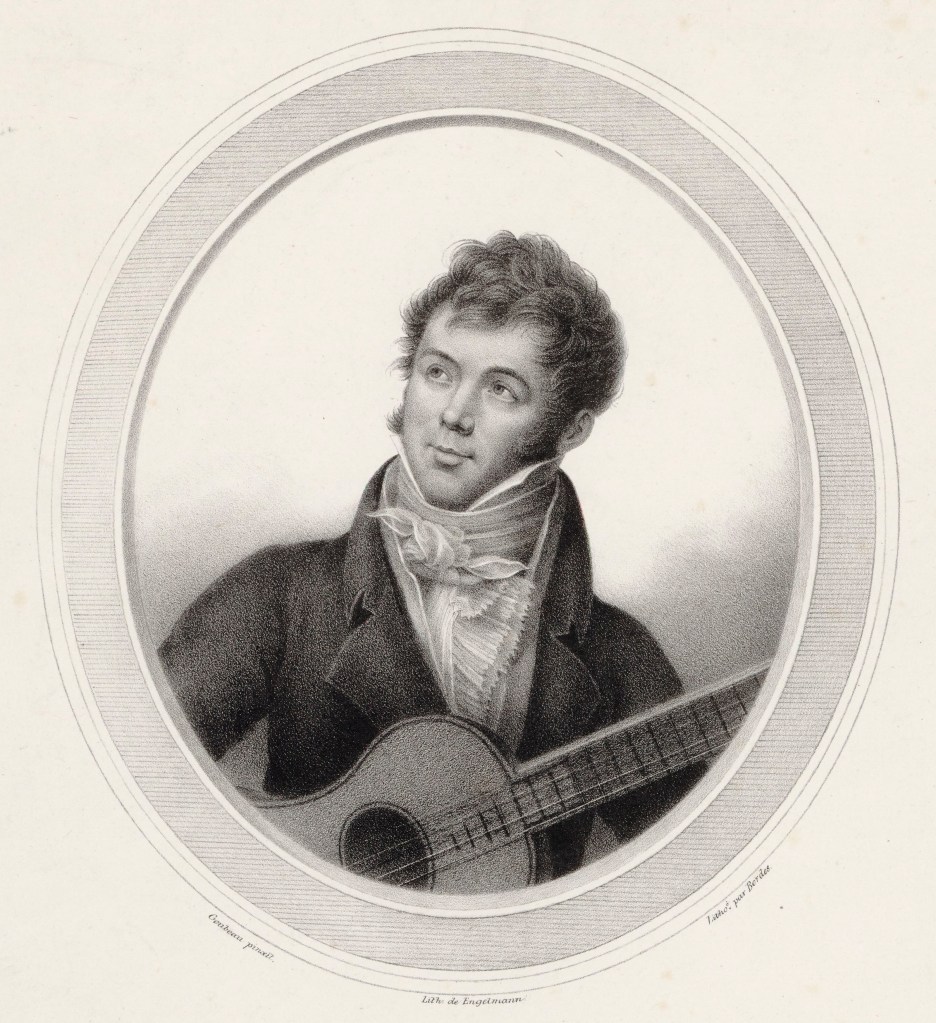
Sor has arguably become the most important guitarist in the nineteenth century. He has been written about extensively, so I won’t go into his biography. Suffice to say, as both a composer and performer, he was extraordinary. (For those who are interested in Sor’s quite remarkable life — including my favourite episode, his astonishing encounter with the Inquisition! — I cannot recommend Brian Jeffery’s biography too highly.)
Sor wrote at length about no-nail playing in his method:
‘Never in my life have I heard a guitarist whose playing was supportable, if he played with the nails. The nails can produce but very few gradations in the quality of the sound: the piano passages can never be singing, nor the fortes sufficiently full. Their performance is, to mine, what the harpsichord was in comparison to the pianoforte—the piano passages were always jingling, and, in the fortes, the noise of the keys predominated over the sound of the wires. It is necessary that the performance of Mr. Aguado should have so many excellent qualities as it possesses, to excuse his employment of the nails; and he himself would have condemned the use of them if he had not attained such a degree of agility, nor found himself beyond the time of life in which we are able to contend against the bend of the fingers acquired by long habitude. His master played with the nails, and shone at a period when rapid passages alone were required of the guitar, when the only object in view was to dazzle and astonish. A guitarist was then a stranger to all other music besides that for the guitar. He would not, indeed, hear any other. …It was at that time that I became acquainted with him. … I but slightly pointed out the inconvenience of the nails, especially as my music was then far less removed from the fingerings of guitarists in general than it is at present, and, by taking a little more pains, he succeeded in playing all the notes very distinctively; and if the nails did not allow him to give the same expression as I did, he gave one peculiar to himself, which injured nothing. It was only after many years that we met again, and he then confessed to me that, if he were to begin again, he would play without using the nails.’1
Aguado, in his Method (published after Sor’s), somewhat contradicts this. He stands by his use of nails, though does inform us that, after hearing Sor, he cut off his thumb nail. He is also more tolerant of flesh playing than Sor is of nails, advising (for reasons I have yet to discover) that ‘persons with very long fingers should not play with the nails’.2
Sor used p, i & m predominantly, only occasionally employing the a finger and never for melody notes unless unavoidable. His little finger would sometimes rest on the soundboard (though less frequently than many of his contemporaries), in order to aid stability. Also, Sor would generally not pluck notes in a run, but slur them with the left hand:
‘As to the right-hand, I have never aimed to play scales staccato, or detached, nor with great rapidity, because I have been of opinion that I could never make the guitar perform violin passages satisfactorily, while, by taking advantage of the facility which it offers for connecting or slurring the sounds, I could imitate somewhat better the passages of an air or melody.’3
Here is Enrica Savigni playing Sor’s Le Calme on a nineteenth-century guitar and using a no-nails technique:
 No-Nail Guitar
Leave a comment