
Alfonso’s father was a student of Francisco Tárrega; the two families were in fact neighbours. At first Alfonso’s father taught his son, then he sent him to study with Emilio Pujol. Alfonso gave his first performance age 13 at the Teatro Escuela, playing virtuosic works such as Danza Mora and Gran Jota. It was a great success. He would go on to perform across the world, from London to South America. A 1929 German guitar journal remarked that,
‘Among the young Spanish guitar virtuosos, the most important is probably Francisco Alfonso, who occupies a special position in that, through fortunate circumstances, the continuation of Tárrega’s tradition can be clearly seen in his case.’1
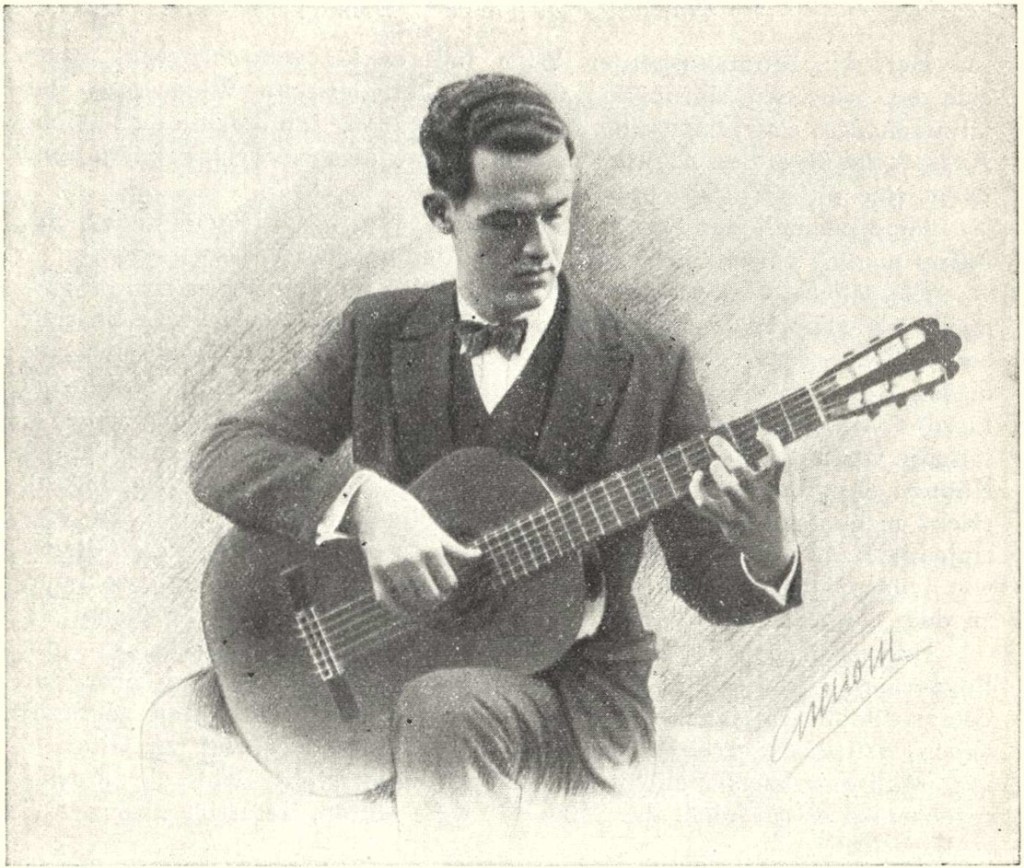
A 1937 review of a London concert by Alfonso:
‘To appreciate such an artist as Alfonso means that you understand the music of the classical guitar. His touch and expression are divine; his strings sing as the human voice; his diapason between fortissimo and pianissimo is extremely wide. His technique is excellent but not mechanical, and here is his difference to Segovia. I have never heard any body else playing “Recuerdos de la Alhambra” so perfectly and with such expression; it must be attributed, in part, to the fact that Alfonso plays with his finger tips and not with the nails like Segovia and Luise Walker. […] there is no limit to his perfection, and we would like to hear him every year in London, affording us the opportunity of watching his brilliant musical career and following his successes’2

Alfonso wrote about the ‘Tarrega School’ and playing without nails:
‘I venture to state that it is not so much a question of obtaining good tone by finger tips or nails; the question of the temperament of each guitarist must be considered. There are nails which are equal to finger tips and finger tips equal to nails, but, in my opinion, it is always easier (conditions being equal) to obtain better sonorousness with the finger tips. From the viewpoint of which is the easier I can only say “this depends upon the work being performed.” The ideal would be a combination of both methods of striking the strings.
‘The “Tarrega School” consists, more accurately, of caressing the strings instead of striking them; of beautifying and avoiding all stridency. It costs a lot of effort on the part of an audience to fully understand the fundamentals of the “Tarrega School,” but once interpreted in its true light it stands apart from all others because it is without artifices and is truly orthodox.’3
A 1940 article describes him as ‘one of the finest of the younger generation of guitarists’.4 Sadly, by the time this article had been published Alfonso had already died a month earlier, aged only 31. He was preparing for a tour of Mexico and the United States and fell ill with malaria on Christmas Eve, 1939. He died on 6 January 1940. In a letter to Alfonso’s widow, Emilio Pujol wrote:
‘I think that our art has lost one of its best representatives. His technique was marvellous and his tone ideal.’5
There are a handful of recordings by Alfonso, for example this 1931 recording of Bach:
- Die Guitarre, 10.9/10 (1929), pp. 72-73. ↩︎
- Dr Boris A. Perott, ‘Brave, Alfonso!’, BMG, 34.387 (1937), pp. 235-236. ↩︎
- Francisco Alfonso, ‘The Tarrega School of Spanish Guitarists’, BMG, 34.387 (1937), p. 238. ↩︎
- https://web.archive.org/web/20151027041417/https://icoldwell.com/robert/music/etude/LVIII_02.html ↩︎
- ‘Francisco Alfonso Dies in Havana’, BMG, 37.419 (1940), p. 115. ↩︎
 No-Nail Guitar
Leave a comment