
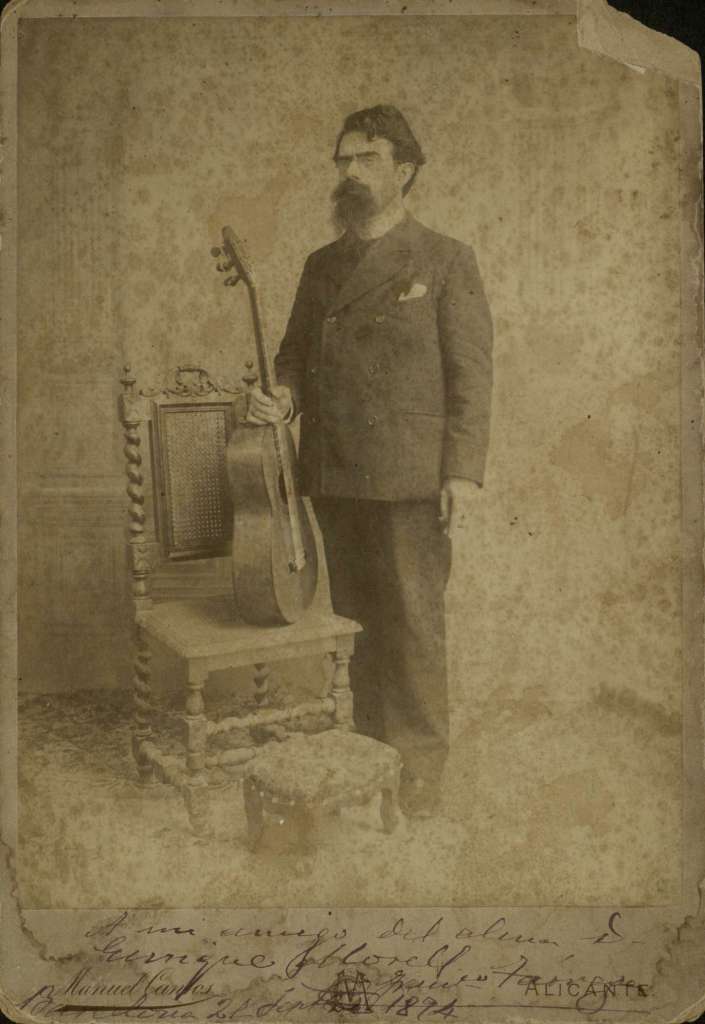
Much has been written about Tárrega, so I will only discuss his use and subsequent disuse of nails. Tárrega cut off his nails at the turn of the century. There are two competing reasons. One, given by Emilio Pujol, is that he cut off his nails in pursuit of his ideal sound. The second, given by Domingo Prat, is that Tárrega suffered from a medical condition that meant his nails become unusable. I believe the weight of evidence is in favour of Pujol. For one thing, after his conversion Tárrega encouraged all his students to follow his example. This does not strike me as the behavior of someone playing without nails merely out of medical necessity. I’ve also never seen Prat’s account corroborated by others who knew Tárrega, while Pujol’s explanation is confirmed by other accounts. But in a sense, it doesn’t matter how Tárrega came upon this way of playing; what matters is that he clearly preferred it, creating a large and influential school of no-nail playing.
It was a new century and the guitar was beginning to reassert itself after a slump in the late nineteenth century. Tárrega’s change of technique was not nostalgic but forward-looking — in search of an improved, ideal sound. We now often view no-nails playing within the context of historic performance, but Tárrega did not: it was about discovering new sounds as the guitar was becoming again a serious instrument.

The ‘Tárrega School’ became enormously influential. Reading accounts of his students and admirers, Tárrega comes across as tantamount to a saint, someone who through sacrifice and diligence elevated the guitar, establishing an unwritten ‘school’ and style, but who did it all in a retiring, gentle, loving way. His students, both with and without nails, were among the greatest guitarists of the time. His no-nail students were particularly prominent, such as Emilio Pujol, Josefina Robledo, Estanislao Marco, Daniel Fortea, and Pepita Roca. They in turn had a number of prominent students who followed the no-nail ‘Tarrega School’, such as Francisco Alfonso, Manuel Cubedo, Miguel Angel Martinez, Hector Garcia, and Jose Maria Sierra. The ‘Tárrega School’ mostly died out with this third generation, sadly. (At some point I’ll discuss the possible reasons why.)
In other respects, Tárrega’s legacy remains strong. His compositions and transcriptions remain central parts of the guitar repertoire. And the mythology around the figure of Tárrega continues to have a certain mystical quality. He is the guitarist’s equivalent of Liszt or Paganini — though a rather different, more interior personality.
There is a recording, either from 1899 or 1908, that may be Tárrega playing, although I think it is more likely not. However, it is a tantalising thought and a fascinating historical document nevertheless!

 No-Nail Guitar
Leave a comment