
Jean Fuller was one of the most promising and active young guitarists of his time. Yet almost immediately after his sudden death in 1950, aged only 23, he was forgotten.
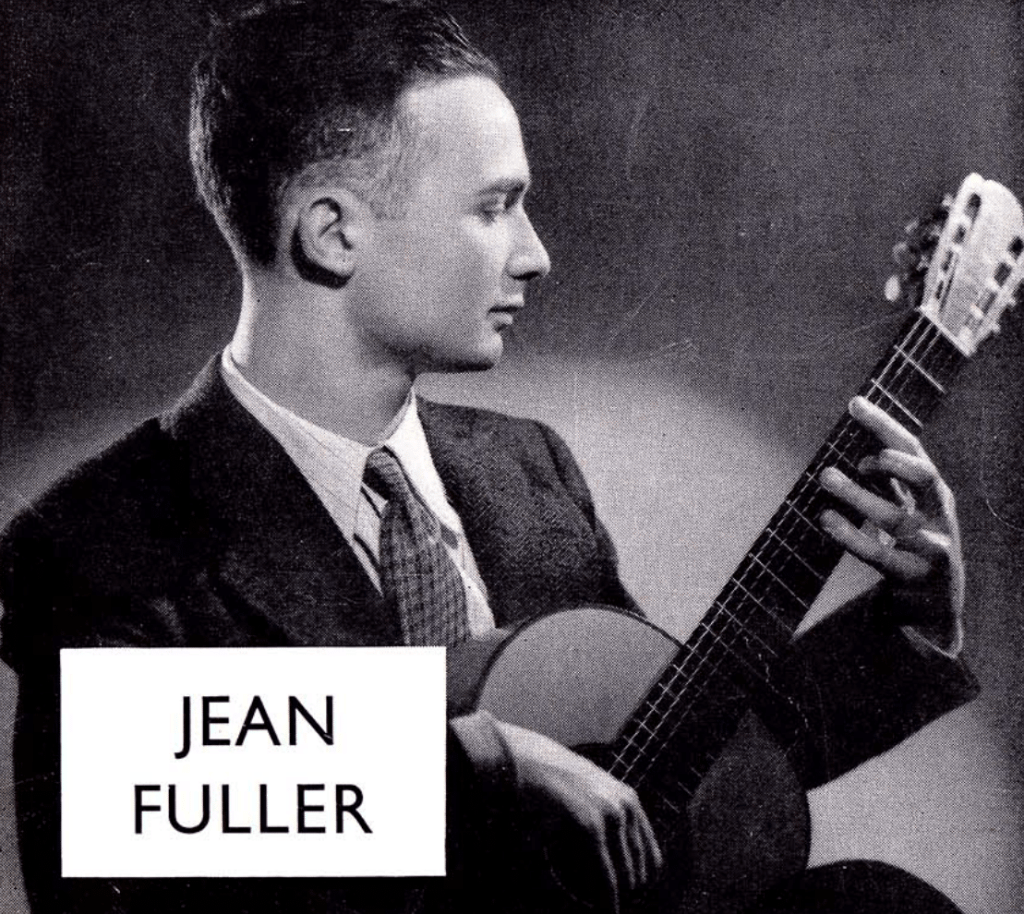
Born in Paris, Fuller was first a child actor. At age 12, he was even offered a film contract in America, but war broke out and he was not able to leave France. He decided to study the guitar instead.1 He evidently made swift progress; in 1945 he gave his premiere concert at the Salle Gaveau, and for the next five years, until his death, he was greatly in demand.
Reviews of his playing are overwhelming positive. Following his debut at the Wigmore Hall, the London Times wrote that,
Mr. Fuller has the feeling for style that allows him to control his natural virtuosity in less spectacular pieces, to avoid kaleidoscopic changes of registration without risking monotony. His playing was everywhere clean, rhythmical, and musicianly.2
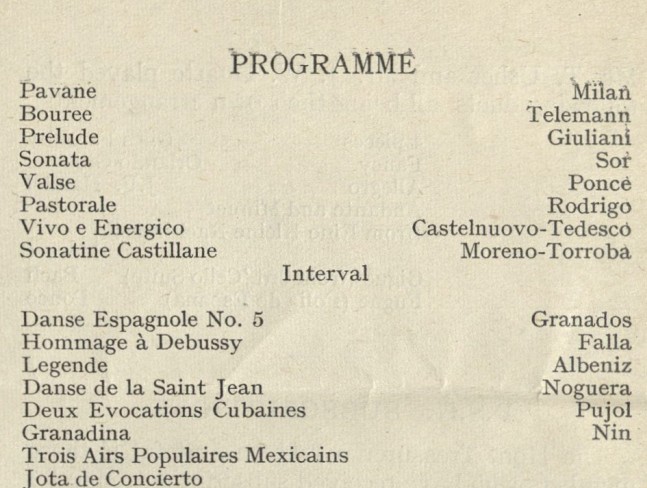
One French newspaper, discussing his tour of Vietnam and Camdonia, wrote that those
who had the good fortune to be in Saigon on 21 April were able to admire the extraordinary virtuosity of Jean Fuller and the prodigious polyphonic power of his guitar. […] At 23, he is not only the greatest French guitarist and one of the greatest guitarists in the world, he is a great musician who reveals to us an almost unknown and marvellous domain.3
From 1946 onwards, he regularly appeared on radio (and occasionally television) across Europe and Asia. Wilfred Appleby, editor of Guitar News and a keen supporter of Jean Fuller, wrote that Fuller gave more than 300 broadcasts between 1946 and 1950.4 Certainly, I have found many radio listings where he appears. Millions of people must have heard his playing.
Sadly but unsurprisingly, the BBC recordings are all lost. However, many of the French recordings have survived and are held by the Institut national de l’audiovisuel. I have heard them all and they are extremely interesting. I cannot share them for legal reasons, but I can at least give you an idea of his playing. The performance quality is varied — understandably, given the frequency of his broadcasts5 — but on the best recordings he demonstrates much sensitivity and an astonishing agility. There is a youthful, often-fiery vigour to his playing (he was in his early 20s in the recordings), and the interpretive style is firmly in the Romantic tradition. Unusually, Fuller played a Torres guitar. I have not been able to track down which guitar it is, or indeed from where Fuller got it, but one 1950 newspaper article reports it was ninety years old, from Torres’ Seville period.6
The best recording of all may be a 1948 performance of Recuerdos de la Alhambra.7 It is a beautiful interpretation and, miraculously, the audio is relatively clean (unlike most of the recorded broadcasts where you struggle to hear the music for all the mechanical noise). Fuller’s tremolo is even and fluent, with excellent expressive control. Indeed, I first discovered Fuller in an article praising the no-nail tremolo of both him and Francisco Alfonso.8
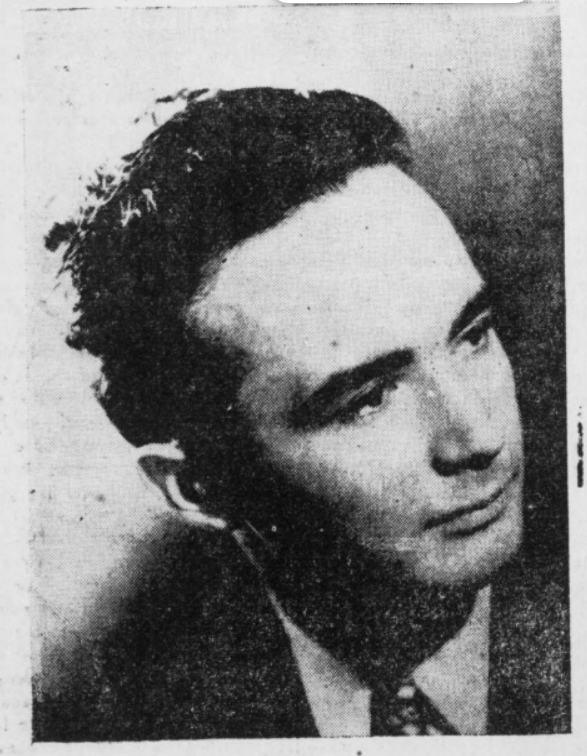
In one instance, Fuller’s broadcasting even became a slight political controversy. He was due to make a broadcast with the BBC in 1948, but at the last moment it was abruptly cancelled by the Ministry of Labour. Daniel Lipson, an Independent M.P. for Cheltenham, then successfully intervened, which resulted in Fuller being permitted several further radio broadcasts.9 So far, I have discovered no explanations — the whole affair is a most curious mystery.
On 13 June 1950, Jean Fuller died in a plane crash over the Persian Gulf, just a few days after performing in Singapore and making several broadcasts for Malaysian radio. It is such an awful tragedy. Who knows what might have been. Fuller’s ambition was boundless, and in five years he had already accomplished so much. In interviews, he stated that he wanted to help form an international federation of guitarists. And if that wasn’t enough, he also hoped to make a film — perhaps drawing on his childhood experience of the industry — about the history of the guitar.10
His death was a significant loss to the guitar world. He deserves to be remembered. If there anyone has further information, please do get in touch. I will continue to search for more. Fuller was reportedly survived by his wife as well as his brother, Jacques, who was a composer of light music.
- He first took lessons with Marius Faraill and then studied at the Paris Conservatoire. However, he would not have studied guitar at the conservatoire, as the guitar department was not established until 1969, under Alexandre Lagoya. See Wilfred M. Appleby, ‘The Spanish Guitar’, BMG 45.519 (1948), pp. 195-196. ↩︎
- ‘Recitals of the Week’, The Times, 23 Jan 1950, p. 7. ↩︎
- Cambodge : le quotidien d’information khmer, 29 April 1950, unpaginated. Translation mine. ↩︎
- Wilfred Appleby, ‘Jean Fuller 1927-1950’, Bulletin of the Philharmonic Society of Guitarists 30 (1950), pp. 3-4. ↩︎
- Wilfred Appleby mentions that, when Fuller performed in the Schubert-Matiegka Nocturne on the BBC, he had only seen the music the day before. See BMG 47.537 (1950), p. 95. ↩︎
- The Straits Times, 4 June 1950, p. 11. James Westbrook suggested the possibility that it might not have been a real Torres, as there were fake instruments circulating. ↩︎
- Que personne ne sorte, 30/09/1948, PHD85025436, Institut national de l’audiovisuel. ↩︎
- Wilfred M. Appleby, ‘The Spanish Guitar’, BMG 47.537 (1950), pp. 95. ↩︎
- See BMG 45.520 (1948), p. 216; BMG 47.544 (1950), p. 253. ↩︎
- BMG 46.523 (1948), p. 23. ↩︎
 No-Nail Guitar
Leave a comment