
When one of Robledo’s brothers was ill and forced to withdraw from social life, their mother hired a teacher to teach him to play the guitar. Robledo would pick up the guitar and strum a few chords for her brother. When he died, the guitar was left unused. However, eventually she decided to learn the instrument herself. She played in a trio with her brothers and quickly developed her skill.
Francisco Tárrega visited Valencia for a concert and Josefina’s father managed to get the maestro to listen to his daughter play. Tárrega instantly recognised her talent and arranged for a lesson the following morning. While Tárrega was in Valencia, Robledo would have lessons with him every morning. When Tárrega returned to Barcelona, Robledo and her mother followed him. A year later, Tárrega stayed with the Robledo family in Valencia after his stroke.1
She is sometimes referred to as Tárrega’s favourite disciple. Domingo Prat wrote that,
‘Of the disciples who followed Maestro Tárrega, from the time he began to play without fingernails, in 1900, none stood out as advantageously as the one we are dealing with.’2
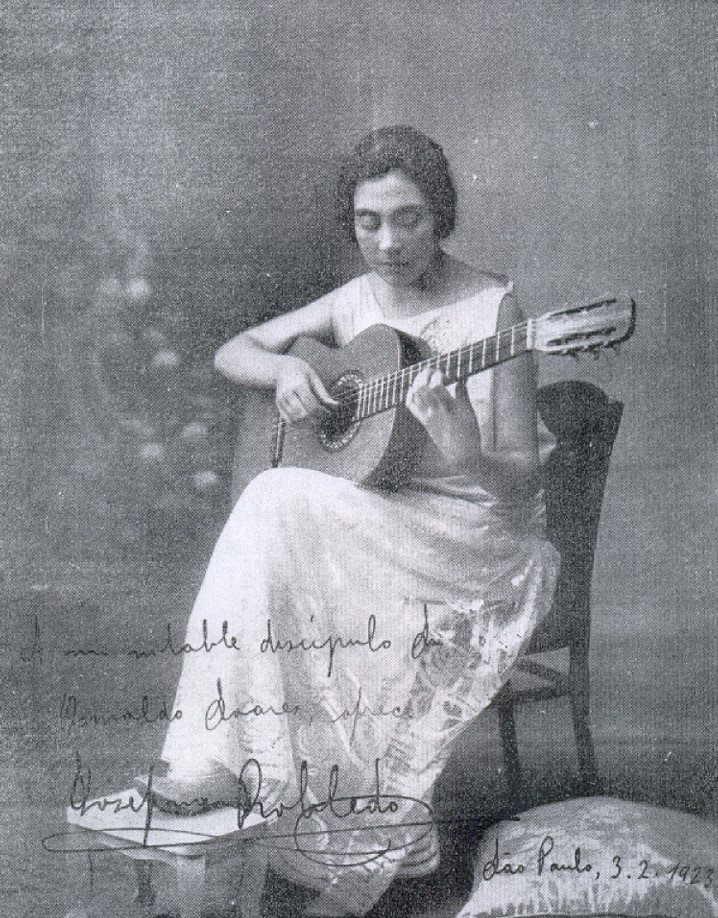
Robledo gave her first recital in 1907 at the Valencia Conservatory, with Tárrega in the audience. She became a successful performer in Spain. Then in her early 20s she went to tour South America and remained there for a decade. She evidently had a considerable influence on the development of the guitar there, establishing a ‘Tárrega School’ pedagogy and repertoire. She was probably the first professional female guitarist to perform in Brazil.
A 1917 reviewer of her first major Sao Paulo performance wrote that,
From yesterday afternoon’s performance […] we were left with an excellent impression. Mrs. Robledo is truly a talented artist, a performer who combines profound technical knowledge with a moving and charming sensitivity. Sober in style, confident in her phrasing, extracting the maximum effects from the guitar strings, Mrs. Robledo knows how to elevate this rebellious instrument to the category of those that, in a public concert, exert the greatest impression of enchantment on the audience.3
A 1928 article reflected on her influence in South America:
The Queen of the Guitar ended her tour of South America here [Rio de Janeiro] and found such charms in our city that she remained here for two years, teaching and laying the foundations of the modern Tárrega school, thanks to which it is now widespread here and in São Paulo, where she left behind countless disciples.4
She taught Maria Luisa Anido for several months while in Brazil, and who later said of Robledo:
She was a woman of extrardoinary technique, very agile. […] Despite playing without nails, she had a beautiful and very powerful sound. I really liked the way she played; her hands were like those of a princess who will always walk among tulle, or something like that – they wouldn’t let her lift even a jug of water, they would chop her food, she didn’t make any effort with her hand, I remember that.5
Robledo had to return to Spain in 1924 due to her father’s ill health. She married in 1927 and afterwards limited her performing to Spain — mostly private events and for friends. Her last performance was in 1959. Fittingly, it was at the Valencia Conservatoire, the same venue as her first ever recital. Moreover, she had organised the concert for the anniversary of Tárrega’s death.
There exist no recordings until after she retired, when she made a handful of home recordings in preparation for a lecture on Tárrega. These are naturally very poor audio quality and long after she had ceased to be a performing guitarist. Nevertheless, you get a glimpse of what a player she must have once been:
- Leandro Márcio Gonçalves, ‘O processo de difusão do violão clássico no Brasil através da “Escola de Tárrega” entre 1916 e 1960’ (Universidade de Évora, 2015), pp. 57-58 ↩︎
- Domingo Prat, Diccionario & Guitarristas (Editions Orphee, 1986), p. 60. ↩︎
- Gonçalves, p. 64. ↩︎
- Ibid., p. 90. ↩︎
- Aldo Rodríguez Delgado, María Luisa Anido (EUNA, 2018), p. 57 ↩︎
 No-Nail Guitar
Leave a comment