
Emilio Pujol regarded Pujol as his most outstanding pupil.1 Indeed, Cubedo’s progress on the instrument was extraordinary. He studied music at the Conservatorio of Valencia, where in 1953 he was awarded the ‘Premio Extraordinario’ and received the title ‘Professor of the Guitar (bear in mind he was only sixteen!)2
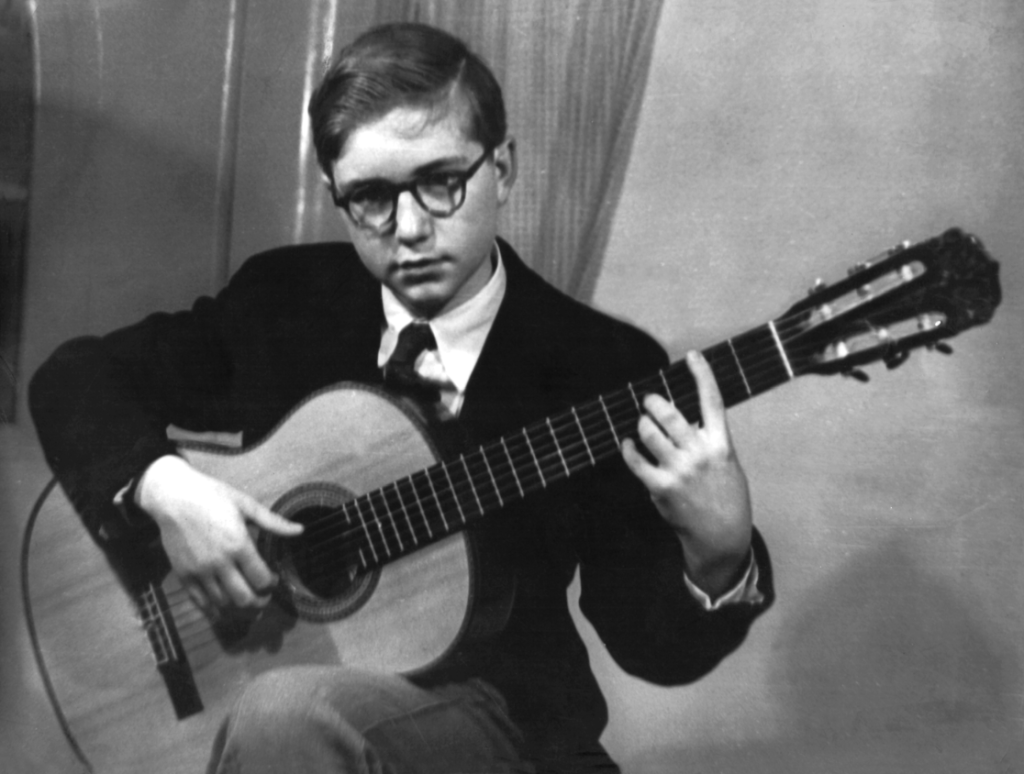
His big break came in 1956, when he won the prestigious International Concert for Musical Performers in Geneva, which had included the guitar was the first time that year. His programme was impressive: Manuel Ponce’s Variations sur Folia de Espana, Robert de Visée’s Suite in D Minor, and Mario Castelnuovo-Tedesco’s Capriccio Diabolico, and finally Tedesco’s Concerto for guitar and orchestra. His prize was followed a dinner with the Queen of Italy, a concert tour and a television appearance.3
The competition was reported on far and wide, and some reviews of Cubedo’s performance discuss his use of flesh rather than nail. Generally, his full and strong tone is praised, as well as his assured technique and musical maturity. Some reviewers, however, do criticize his alleged lack of tonal variety is criticised. One Italian reviewer opined that,
‘Manuel Cubedo showed great confidence, dominating the orchestra very easily, but here too he was content with too limited sound registers. As for Antonio Membrado [his competitor], he was more relaxed and his sound seemed less powerful (unless the orchestra played a little louder…), but still varied, and his interpretation was, in my opinion, more interesting and richer in nuances than that of his companion.’4
I would draw readers’ attention to the interesting fact that Cubedo was reportedly a louder player than his competitor, who played with nails.
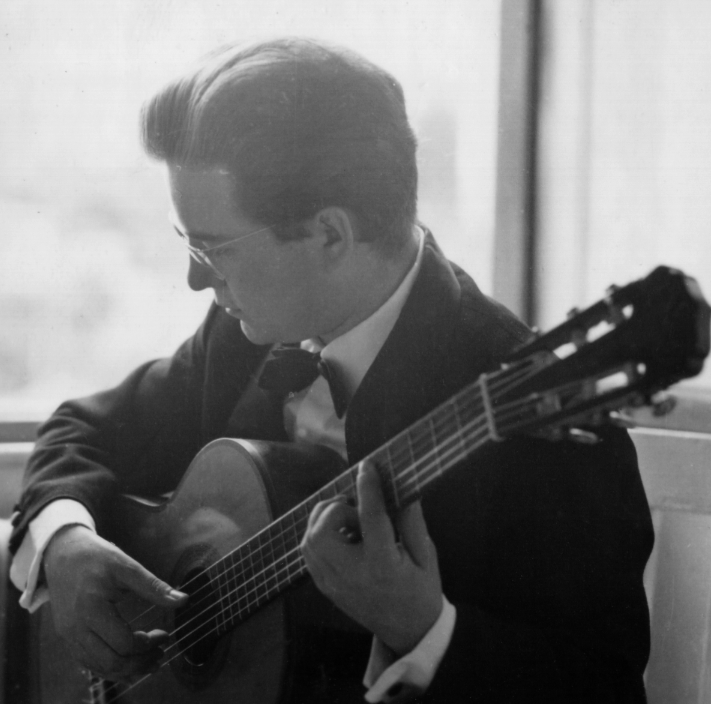
Months before the competition, Cubedo participated in Andres Segovia’s masterclass in Siena. Segovia was not kind:
‘When Cubedo came to Siena, and began to play, after a few bars Segovia stopped him and said: you can’t be heard. Turning to those about, Segovia asked them. Some agreed, others kept their own counsel. Segovia called John Williams, and asked for the same piece.
‘That’s the way, said Segovia.
‘Pujol, of course, was not present. Afterward, P. noted that Cubedo was cast down. In the evening P. met Segovia crossing the square and asked what had caused Cubedo’s depression. Said Segovia: Look, it’s not a question of ruining his career for some little thing. But the fact is he can’t be heard. Said P: You surprise me, for he has given three concerts in Lisbon with many encores: there was no question of him not being heard.’5
Cubedo would tour most of Europe and elsewhere, including performing with many orchestras. Again, I’ve found no question his not being heard. One of the things you soon discover when researching the history of no-nails is that both sides of the debates could be extremely prejudiced, and their accounts of players and performances should be read with this in mind.
Although he was a remarkably successful guitarist — recording many albums, for example, and chairing the XXXIV International ‘Francisco Tarrega’ Competition — in the 1960s he began to turn away from the classical guitar, seemingly for financial reasons. He learnt the electric guitar and became a studio musician, and soon became Artistic Director of Belter Records, the biggest record company in Spain at the time. Then when Belter went bankrupt, he was hired by RCA/Columbia. He continued to make some classical guitar recordings (though it is hard to ascertain the exact dates). Unfortunately, he had several cerebral embolisms over a number of years and fell ill with many ailments from which, eventually, he could not recover.6
He made a number of recordings that testify to his skill and sensitivity. I love his recording of the Tedesco concerto. Released in 1977, it was his final classical guitar recording. The third movement:
- Javier Cubedo’s recollections of his father, https://rmclassicalguitar.com/cubedo/ ↩︎
- Guitar News, 25 (1955), p. 2. ↩︎
- Manuel Cubedo, ‘Impressions of Geneva’, Guitar News, 34 (1957), pp. 2-4 (p. 3). ↩︎
- Jacques Breguet, ‘La Chitarra al concorso di genevra’, L’arte Chitarristica, 10.59 (1965), p. 4. ↩︎
- J. D. Roberts, Guitar Travels (Artes Gráficas Soler, 1977), p. 245 ↩︎
- Javier Cubedo’s recollections. ↩︎
 No-Nail Guitar
Leave a comment