
One of the surprising things I keep noticing in historic guitar methods is the suggestion to use the right-hand little finger in plucking the string. So far, I’ve found reference to over twenty guitarists who advocate its use from the early nineteenth to the early twentieth century. The earliest is Simon Molitor, who, in his Grosse Sonate (1806), recommends it for five note chords, such as in the following passage. If one plays the bottom two notes with the thumb, it might make the bass sound heavy and over-emphasised; using five fingers makes the chord easier to balance:

This is the most common reason for using the little finger1 — particularly for chords where it would be impractical to use the thumb because the two lower notes are non-adjacent. To demonstrate, see this example from Johann Jakob Staehlin’s 1820 method, for which he recommends using little finger.

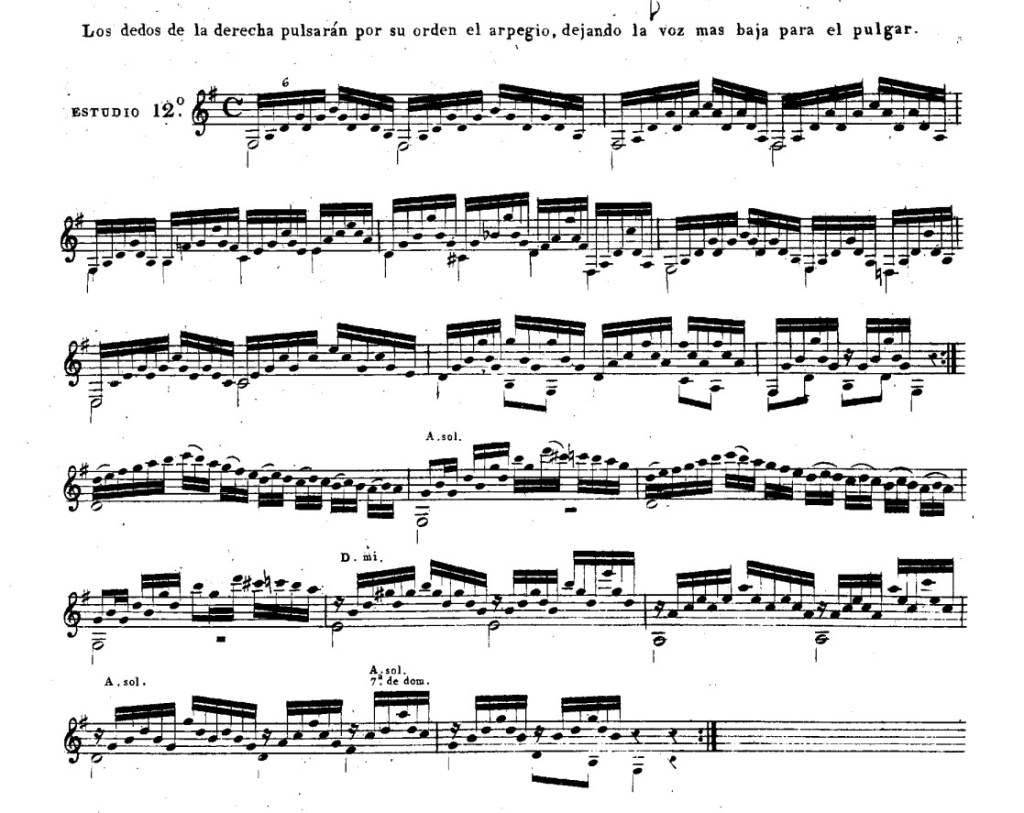
Aguado suggests using the little finger in at least one edition of his method. He also has an arpeggio study which implies use of the little finger; the text at the start of the study translate as, ‘the fingers on the right hand will play the arpeggio in order, leaving the lowest voice for the thumb.’2
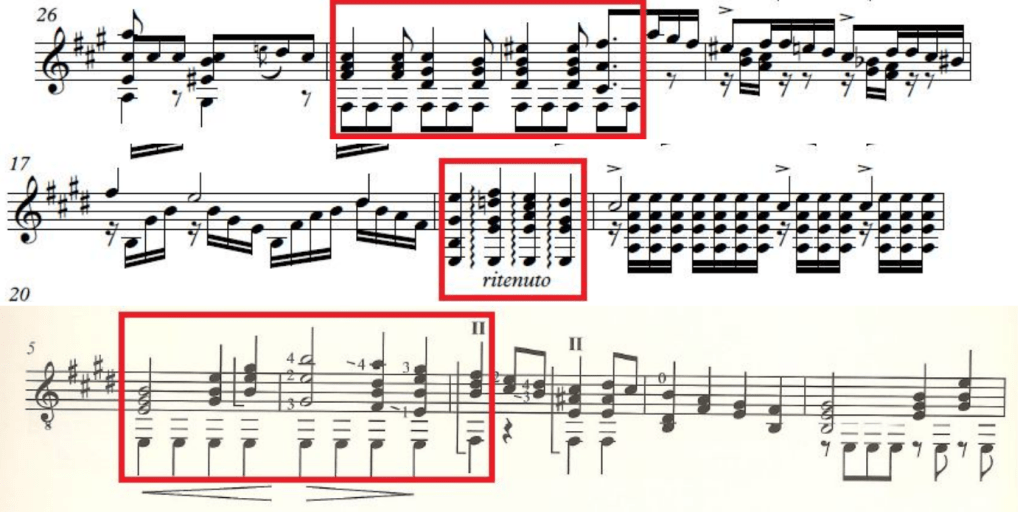
A few other methods go even further and recommend using the little finger equally, or almost equally, with the other fingers. Ledhuy and Guthmann say to use little finger equally with the others. Fleming and Sarrablo also seem to imply equal use. Additionally, there are composers whose music seems to suggest use of the little finger. For example, this piece by the 19th century Dutch virtuoso K. A. Craeyvanger:
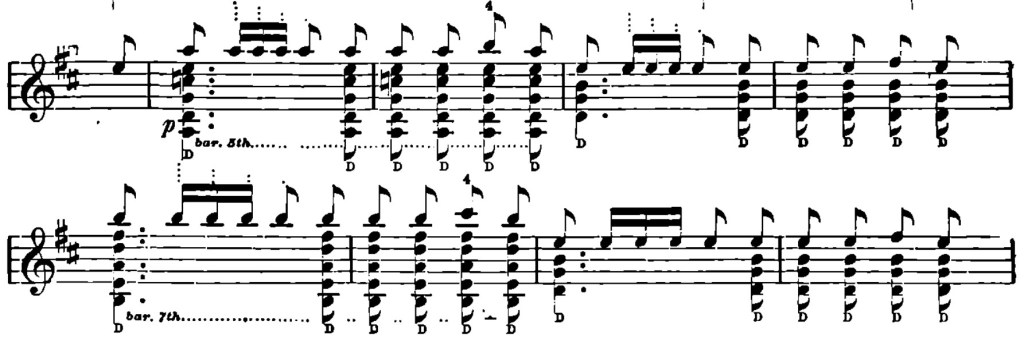
A novel example is from Sebastopol, by the American nineteenth century guitar Henry Worrall (born 1825), who used the little finger for a speed burst effect:
Nicolai Makaroff (1874) suggests using the little finger for its particular tonal characteristics: ‘it is only with this finger that one can draw the sweetest, most flute-like sounds’. This may particularly apply when playing without nails, for although it is possible to homogenise the fingers, most people have fingertips whose shapes and timbre vary. In my experience, the little finger, being thin and less fleshy, produces an especially clear and penetrating sound.
On the subject of nails, there is no observable correlation between nail use and use of the little finger. Nor is there an observable correlation between using the little finger and resting it on the soundboard. On the one hand, one might think that resting the finger would inhibit its use; this does not appear to be the case, given that most methods that advocate plucking with the little finger also advocate resting it. On the other hand, resting may in fact be advantageous, as it makes the hand tilt towards the little finger, from which position it is easier to pluck the string with said finger. In a more ‘modern’ hand position, the little finger is farther away from the strings.
I should also note that the use of the little finger is spread across geographies and periods. From this I infer it may have been fairly widespread practice among advanced and concert players.
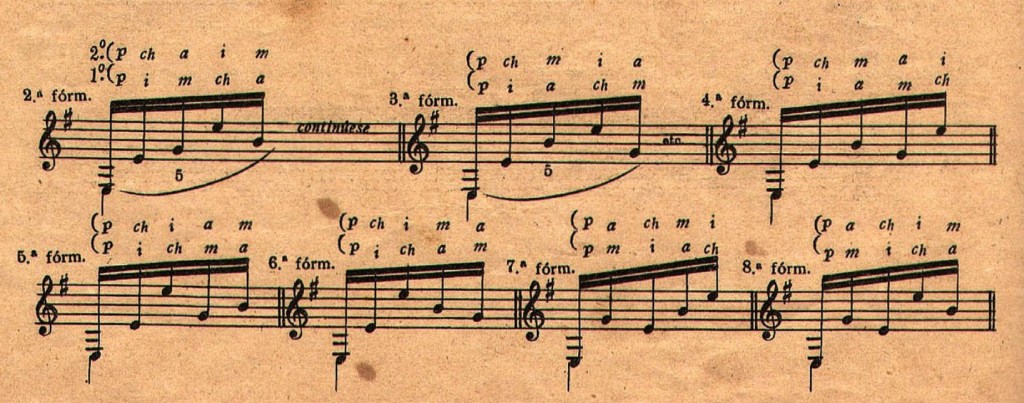
Going into the twentieth century, Villa Lobos reportedly used it, for example. In the 1920s, Domingo Prat wrote a method on using the little finger. He also advocated reversing the fingers (see example below). I find this works better in a Tárrega-like wrist position. Otherwise it’s rather less comfortable. Later in the century Stepan Rak and Charles Postlewate would advocate for its equal use, including techniques like four-finger tremolo.
In conversations with current guitarists, I’ve been surprised to discover how many use the little finger for chords, timbral effects, harmonics, and much else. The use of the little finger seems to be almost a secret technique, often practiced but seldom written about. Perhaps this has been so throughout the history of the six-string guitar?
- See Foden, Curtiss, Bateman, Staehlin, Graffer, Bathilio, Swoboda, JMG y E, and Weiland. ↩︎
- The study is not present in later edition. Weiland also recommends the little finger for some arpeggios. ↩︎
List of Sources for Guitarists Using the Little Finger:
Aguado, Dionisio. Escuela de guitarra (Fuentenebro, 1825), p. 83 [Study 12 is an arpeggio study that implies use of little finger.]
Aguado, Dionisio. New Guitar Method, ed. Brian Jeffery, trans. Louise Bigwood (Tecla Editions, 2004), p. 170
Bathioli, Franz. Gemeinnützige Guitareschule (A. Diabelli und Comp, 1827), p. 37
Cottin, Alfred. Méthode complète de guitare (Paris: Alphonse Leduc, 1894), p. 3
E., J. M. G. Rudminetos para tocar la guitarra por música Música notada (Imprenta de Álvarez, 1819), p. 20
Ferguson, Robert, ‘Henry Worrall (1825-1902): Anglo American Guitarist’, Soundboard Scholar, 2 (2016), p. 10 [For references to the use of the little finger by Worrall, N.P.B. Curtiss, William Foden, and William O. Bateman.]
Fleming, Chas. W., Fleming’s Method for the Guitar (Metzler & Co., Ltd., 1897)
Gräffer, Anton. Guitarre Schule (Anton Strauß, n.d. [1811]), p. 9
Guthmann, Friedrich. Anweilung die Guitarre (C. F. Peters, n.d.), p. 6
Hackl, Stefan, ‘A Survey of Nineteenth Century Viennese Guitar Methods’, Soundboard, 35.3 (2009), p. 18 [Reference to Matiegka using the little finger.]
Hackl, Stefan. Die Gitarre in Österreich: von Abate Costa bis Zykan (StudienVerlag, 2011), p. 59 [For reference to Padowetz prescribing use of the the little finger]
Ledhuy, Adolphe. Méthode de guitare (the author, n.d. [1834]), p. 7
Makarov, Nicolai. Some Rules for Superior Guitar Playing (A. M. Kotomin, 1874), p. 11
Molitor, Simon. Grosse Sonate fur die Guitare (Artaria, n.d. [c. 1806]), p. 6
Prat, Domingo. La Nueva Técnica de la Guitarra (Romero y Fernandez, 1929)
Rusanov, Valerian. School for Seven-String Guitar (Tyumen: A. M. Afromtsev, 1913), p. 27 [Also mentions that A. A. Vetrov used the little finger.]
Sarrablo, Manuel. Método Racional (Zaragoza, 1890), p. 7
Staehlin, Johann Jakob. Anleitung zum Guitarrespiel (Johann Andre, 1811), p. 4
Swoboda, August. Guitarre Schule (Wien, n.d.), p. 5
Weiland, Francis. Instructions for the Spanish Guitar, Philadelphia: G. André & Co., n.d.], p. 10
 No-Nail Guitar
Leave a comment