
Originally published in Soundboard 52, No. 1 (March 2026)
One of the most vexed debates in the guitar’s history is whether to play with nails or flesh alone. A persistent assumption – sometimes explicit, usually tacit – is that there is no middle ground. For Emilio Pujol, the foremost advocate for no-nail playing in the twentieth century, the question of nail versus flesh was
just as important a question of dogma as is a problem of belief for a moralist. The aesthetic opinion of each partisan reflects his personal nature. Every preference requires an attitude distinctive from the rest and finally leads to diametrically opposed positions […] The respective timbre is very different and as it is impossible for the same set of fingers to exercise both methods at once, the guitar player must decide in favour of the one or the other. There lies the problem. Which method is to be preferred?[1]
Pujol would compare no-nail playing to the more unified sound of the harp, piano, or string quartet, in contrast to an orchestral conception of the instrument exemplified by nail players such as Miguel Llobet and Andrés Segovia.[2] Although his preference was for flesh playing, Pujol was tolerant of nails – most of his students used them. “Some people think I prefer the sound without nails,” he said to students in 1973, “but the principal things is to have a good sound, whether with or without nails.”[3] Nevertheless, he continued to believe that they are “distinct and parallel sonorities”[4] that could co-exist but are intrinsically separate.[5] This was not just on account of physical incompatibility – Pujol also viewed the flesh/nail debate ideologically. The guitar offered a “duality of aspects”, he argued: “the one [nails] spectacular and tending to exteriorize one’s personality, and the other [flesh] intimate and sincere, deeply penetrated by the spirit of art.”[6]
Beautifully expressed though it is (Pujol is surely one of the guitar’s finest writers), Pujol and others made the mistake of turning a distinction into a division. The first thing to note is that there have been players who converted from nail to flesh without a radical change in their style.[7] Nor can one draw any general conclusions, especially about personality, when examining the repertoire, interpretations, and timbres of flesh versus nail guitarists (there are “naily” flesh players and “fleshy” nail players). And most curiously of all, there have been guitarists, both historic and contemporary, who have discovered various ways to alternate between nail and flesh.
Indeed, in a fundamental sense, neither flesh nor nail technique can be entirely exclusive. While there have been nail players who insist they do not use the flesh, most cultivate a right-hand stroke that combines flesh and nail at the initial point of contact with the string. For no-nail players, there is also a sense in which the nail is used, for although it never touches the string it does have a role in supporting and shaping the fleshy fingertip.
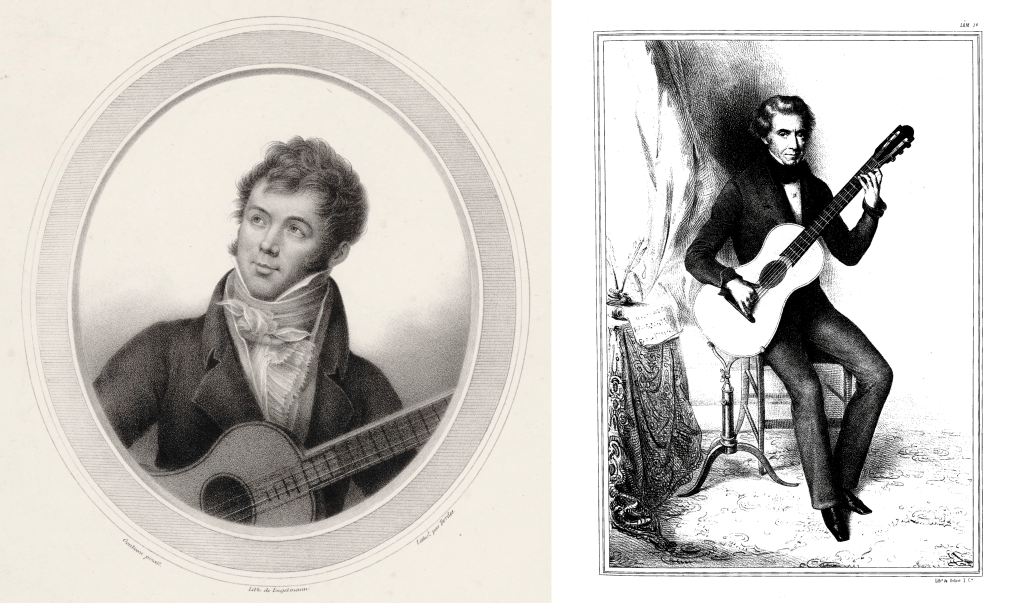
Let us go further. Fernando Sor and Dionisio Aguado are, respectively, the two most well-known exponents of flesh and nail techniques in the nineteenth century – yet neither adhered wholly to either technique. Sor used his nails as a special effect, and Aguado, influenced by Sor, cut off his thumbnail.[8] Sor and Aguado are far from the only players who used a hybrid stroke, wherein nail and flesh technique can be used alternately. There are many examples, both historically and in the present day. They fall into three categories:
Growing and cutting off one’s nails as needed
This is the most straightforward way to alternate. I do not know of any historic examples,[9] but some contemporary players do this, such as Brandon Acker, who has made several YouTube videos using both techniques.[10] Nicola Pignatiello does something similar: he uses very short nails as a default, which then enables him to either file down his nails entirely or grow them out further, depending on the instrument and strings he is using. For guitar or lute with gut strings, he uses no nails; while for theorbo with nylgut, or guitar with nylon, he uses very short to medium-length nails.[11] Duo Maccari-Pugliese played without nails for their album of music by Sor and Coste;[12] they found that it worked better for French guitars with a low pitch, whereas for Italian or German guitars at 430hz they found nail more useful.[13] Pascal Valois, who also specialises in nineteenth-century guitar, recorded two albums without nails,[14] and used nails for the other three. Valois said he would play most romantic music without nails if he could but finds it difficult to go back and forth.[15]
Alongside the unavoidable wait for the nails to regrow (unless using false nails), the physical difficulty is the chief problem with this method of alternation. Especially if one goes for long periods without alternating, the unfamiliar sense of touch can be an issue. The switch to flesh is generally the more problematic. In my experience, Pujol was right to say that it is easier for a player to change from flesh to nail than the other way round.[16] The fingertip offers more resistance than the nail, and it takes time for the skin of the fingertips to adapt to its new role.[17]
Using of a combination of fingers with and without nails
This is where a player has nail on one or more fingers but not the other(s). The most common configuration is to have no nail on the thumb and nail on the fingers. Aguado appears to have been the first guitarist to suggest this,[18] and a number of guitarists used it after him. Ignacio Augustin Campo and Jose Campo y Castro (brothers) both advocated it in their methods;[19] their father, Benito Campo, published Aguado’s music, and Aguado mentions both sons as his students in the appendix of the 1849 edition of his Nuevo método para guitarra.[20] Manuel Sarrablo’s 1890 method also implies no thumbnail is used,[21] and Francisco Cimadevilla’s method (c. 1893) implies no thumbnail when he writes that nails should be grown on the “indice, medio y anular” fingers, omitting mention of the thumb.[22]
This configuration was also used in the twentieth century. Carles Trepat recalls José Tomás saying that Miguel Llobet mostly used the pad of his thumb and very little fingernail.[23] Luise Walker, who did not use thumbnail herself, also recalled that Llobet had a very short thumbnail.[24] However, it is possible to have a very short thumbnail and still use it (just as it is possible to have a very long thumbnail and not use it, depending on the hand position). We do know that Maria Lusie Anido, who studied and performed with Llobet, used nails on her fingers and no nails on her thumb.[25] Graciano Tarragó (and possibly his daughter Renata) also did not use his thumbnail.[26]
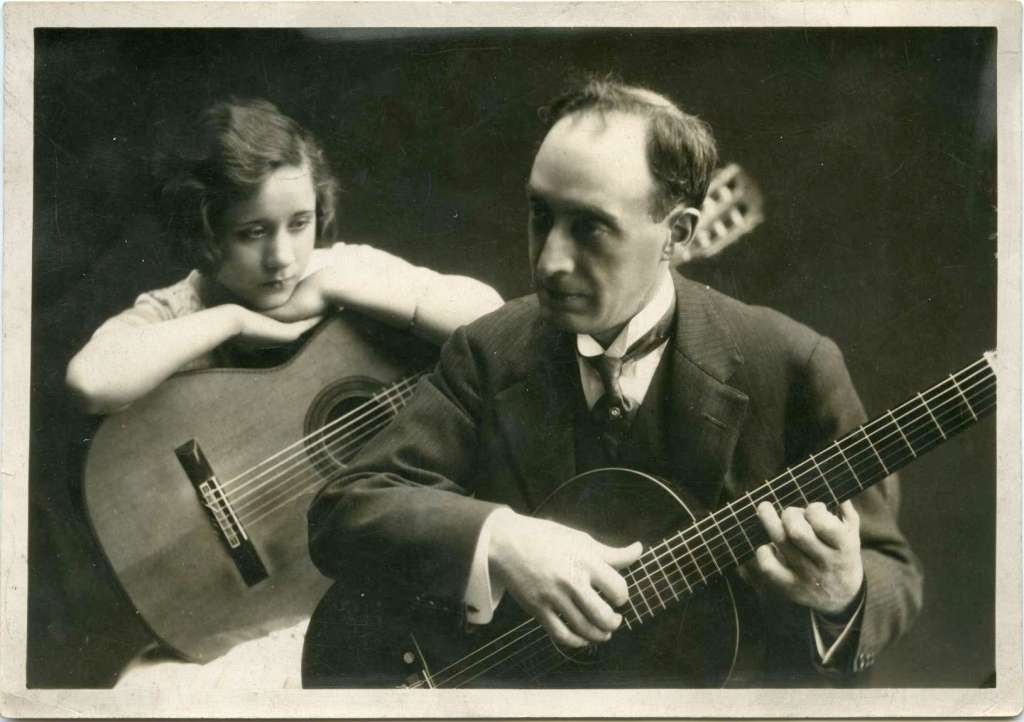
There is a curious 1931 article by Alexis Chesnakov (a Russian émigré who became an important guitar teacher in London) in which he stated that “the thumb nail is never used” when playing the “Spanish guitar”. Chesnakov seems to have been acquainted with various prominent guitarists (such as Llobet); if they used their thumbnails, one would have expected Chesnakov to have noted this in his article, rather than categorically stating that “the thumb nail is never used”.[27] However, there are confirmed examples of early twentieth-century guitarists with long thumbnails, such as Heinrich Albert;[28] Luigi Mozzani even used a thumb-pick.[29] It may be that the use of nails on the fingers and no nail on the thumb was more common within the Spanish guitar tradition.[30]
There were at least two notable players, Carl Blum in the early nineteenth century and Daniel Fortea in the early twentieth, who used the opposite configuration: nail on thumb, and no nail on fingers.[31] There are some other possible variations as well. Juan Mercadal played without nails until 1965, when he reportedly grew nails but only on two fingers (m and a).[32] It is not clear whether he used the nails consistently or only for special effect. (There is a possibility that Aguado may have used a similar configuration, at least for a time; in Nouvelle méthode de guitare, he wrote that he has nail only on i and m.[33]) David Starobin opted for the opposite configuration on his album Fernando Sor: Les plus belles pages: nail on p and a, and no nail on i and m.[34] Another possibility is used by Jamie Akers, who plays without nails except on his little finger; he finds the nail especially useful for playing artificial harmonics.[35]
Alternating by nail shape and/or change of hand position
Among nail players, this is commonly practised on the thumb – that is, switching to a flesh-only attack, usually by lowering the wrist. It is also common for flesh players to curl their fingers inwards in order to attack the strings with their nails (as Sor did). Both these techniques are used sparingly as special effects. There are, however, tantalising hints that a more frequent alternation between flesh and nail was practised. The earliest example may be António da Silva Leite, who wrote in his 1796 Estudo de guitarra,
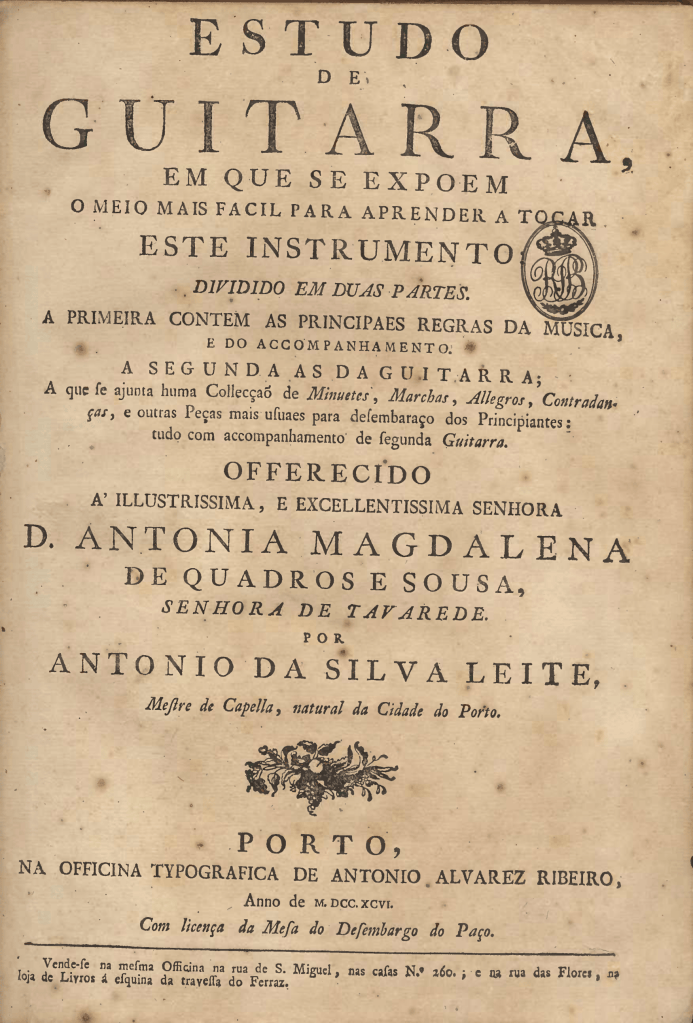
The strings of the guitar, the so-called ‘Body of Sound’, in order to cause its precise effect, must be played with the flesh of the fingers, as well as the tips of the nails: this is true when not playing piano, and, when played piano, this must be done only with the flesh, and never with nails, in order to make the expected strings sound more beautiful and amenable.[36]
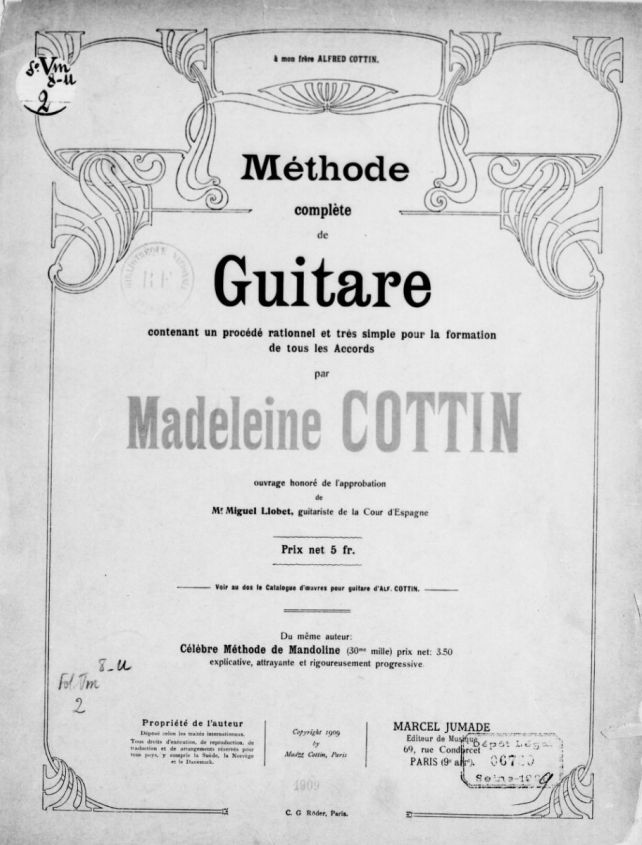
Another reason for alternating is given by Madeleine Cottin in her 1909 method:
From the beginning, the student should apply himself to obtaining the purest possible sound; this is why we recommend attacking the strings with the fleshy end of the finger and not with the nail. (This is also the way to proceed for the Harp, a similar instrument.) When the student is familiar with this attack, he will be able from time to time, mainly to execute detached notes with a certain speed, to attack the strings with the nail, but without harshness.[37]
Philip J. Bone wrote that Cottin’s method had sold 150,000 copies by 1914, though his book is often unreliable.[38] Even though it may have been popular, I can find no direct evidence that others shared or adopted her hybrid technique. A writer who does appear to suggest a similar technique is Erwin Schwarz-Reiflingen. In his 1927 book Schule des Gitarrenspiels, he mentions a special form of stroke in which the nails are short enough that one can either use them or else play without them by lowering the wrist and bending the fingers outwards slightly.[39] Later in the Schule, Schwarz-Reiflingen wrote that this technique, while theoretically important, is practically difficult, requiring very careful nail care and special study.[40] Notably, Schwarz-Reiflingen gives examples of nail players and no-nail players, but he does not give any examples of those who use this hybrid approach, raising the question of whether, for Schwarz-Reiflingen, it was a purely theoretical technique.[41]
Phillip de Fremery has concluded, from his studies with Segovia, that Segovia had a special stroke in which he avoided the nail.[42] Very short nails may have been commonplace on gut strings,[43] which would make such a stroke more feasible (Alexis Chesnakov wrote that Llobet’s nails “scarcely extend beyond the finger tips”).[44] It is also curious to note that Walter Kaye Bauer and Ivor Mairants mistook Segovia and Anido respectively as no-nail players, despite hearing them perform and spending time with them one-on-one.[45]
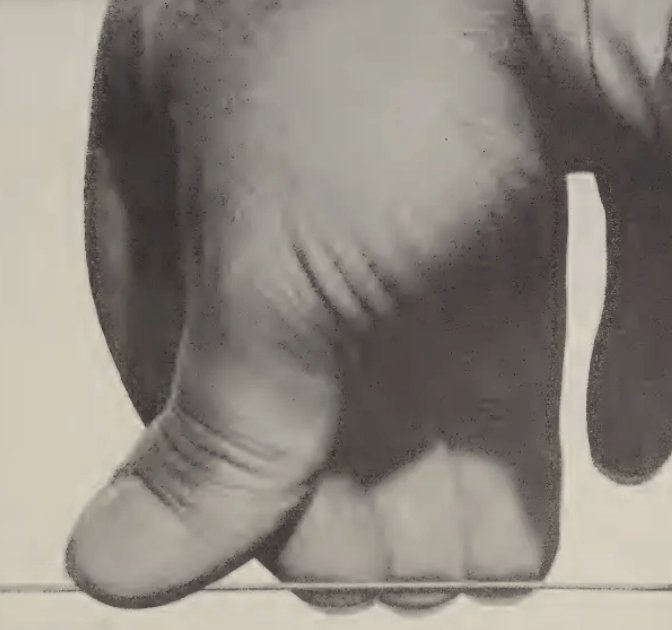
There are various possible explanations. Most likely, Bauer and Mairants were completely mistaken (you might be surprised how often this is the case). Or perhaps neither Segovia nor Anido were using a thumbnail, and given that when playing this is usually the only visible nail, Bauer and Mairants would have understandably concluded that no nails were used. It is also possible that players like Segovia and Anido might have been able to employ a flesh-only stroke from time to time, further confusing Bauer and Mairants; especially if playing on gut, there would be a practical as well as aesthetic advantage to this.
Although we lack clear historical examples, there are at least two modern players who do something similar, Lorenzo Micheli and Fabricio Mattos. Micheli sought to develop a hybrid technique that would allow him to play both modern and early instruments. He has very short nails and by changing his hand position can switch to very little or no nail when stylistic or colouristic reasons require it.[46] His thumbnail is especially short; he uses only the tiny left corner of the nail, switching to flesh often.[47]
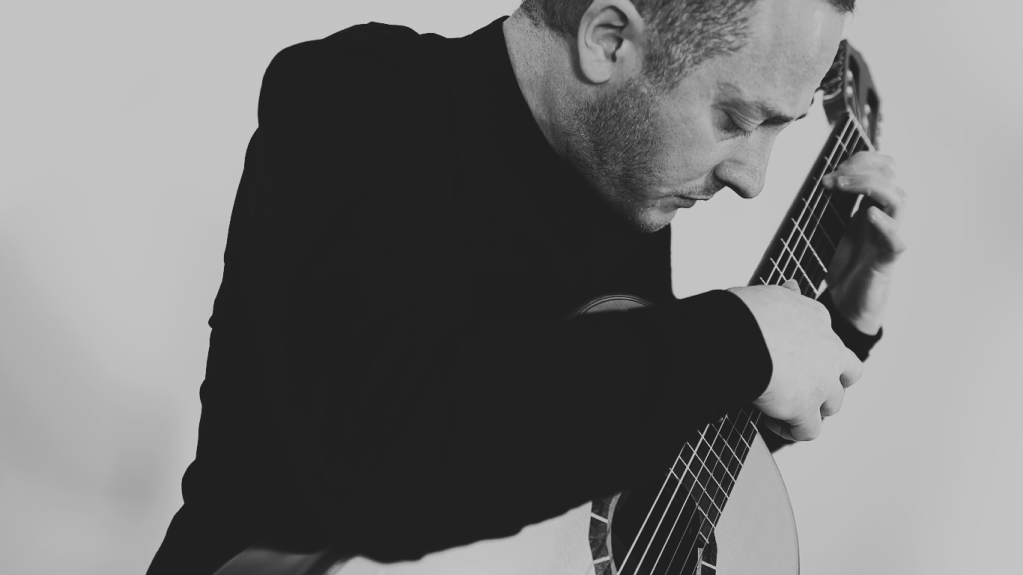
Fabricio Mattos’ development of his hybrid technique was born of a desire to explore the possibilities of gut strings on his Stauffer-style guitar, both with and without nails. However, this was more an aesthetic and practical experiment than an historic one; he wanted to achieve the widest possible range of colour and articulation.[48] In addition to using the technique for performing nineteenth-century music, in 2015/16 he commissioned new works for his project Worldwide Guitar Connections, some of which used his particular right-hand technique for its extreme timbral possibilities.[49] Mattos uses nails that as short as possible and only grows out the right side (palm facing); he uses the left side of the fingertip to play without nail. This is partly facilitated by a slight rotation of the hand, so that the palm is facing more towards the player, sometimes with the little finger resting on the soundboard. This technique does not, however, require that all fingers alternate together. For example, he can use flesh for a melody line while still using nails for the accompanying figure.[50]
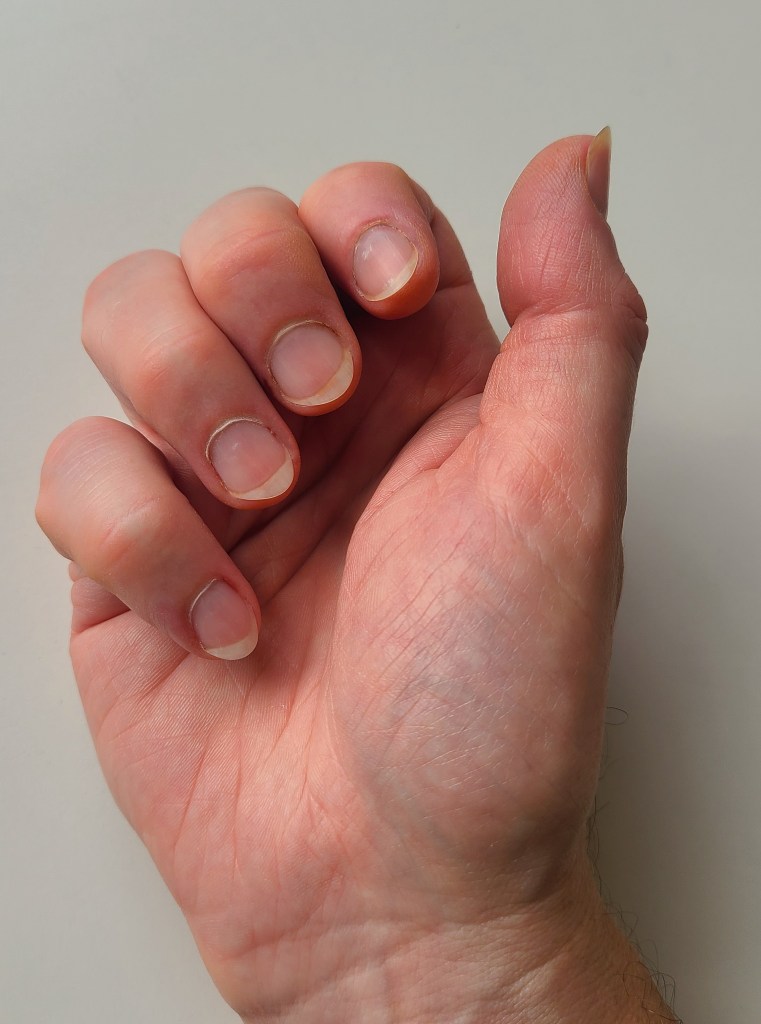
Both Mattos and Micheli are predominantly nail players who sometimes use a flesh-only stroke, but a similar technique can be used by a flesh player (like myself) who would like to sometimes use a nail stroke. Experimenting with the technique, I found it worked surprisingly well, albeit with one limitation: the more I incorporated the nail, the less easily I was able to use a flesh-only stroke, or vice versa. The extent to which this is the case will vary depending on the anatomy of the player;[51] but a perfectly equal alternation between flesh and nail may not be practicable (if only guitarists had the retractable claws of cats).
In the broadest sense, Pujol may have had a point: a player will likely have to decide which technique is to predominate. However, there is certainly no reason for this decision to harden into a “dogma,” as Pujol described it (and indeed his later writings suggest he may have softened on this point). Thankfully, there is a great range of ways that flesh or nail players can incorporate aspects of each other’s techniques, should they wish.
[1] Emilio Pujol, “Polemics for Guitarists: The Dilemma of Tones,” Austrian Guitar Review (English Edition) (1930): 9.
[2] See, for example, Emilio Pujol, Notes íntimes per a una biografia, ed. Jordi Guimet i Perenya, 121. https://www.associacioemilipujol.cat/notes.html#all. As far as I know, Pujol never mentions that Fernando Sor (who played without nails) also used orchestral metaphor when describing the timbral possibilities of the guitar. Moreover, it is curious to note that Pujol’s music nevertheless contains various timbral effects, such as his varieties of pizzicato: libre, apagado, and estridente. See Emilio Pujol, Escuela Razonada de la Guitarra: Basada en los principios de la técnica de Tarrega: Libro Primero (Buenos Aires: Ricordi Americana, 1956), 97. (In the score of Guajira, Pujol refers to them respectively as ouvert, naturel, and strident.)
[3] John D. Roberts, Guitar Travels (Artes Gráficas Soler, 1977), 520.
[4] Emilio Pujol, “La guitare,” in Encyclopédie de la musique et dictionnaire du conservatoire: Deuxième partie technique – esthétique – pédagogie, ed. Albert Lavignac and Lionel d. La Laurenscie (Paris: Libraire Delarave, 1926), 2023.
[5] John Roberts recalled that in 1975, “He [Pujol] has been to Italy, presiding on the panel of the Competition “Fernando Sor,” and comfortably lodged in the Spanish Embassy. At the moment of award he disagreed with his fellow-judges, and abdicated. All the competitors were nail players, and he would not, in the name of Sor, award the prize to a nail player.” See, Roberts, Guitar Travels, 640.
[6] Emilio Pujol, El dilema del sonido en la guitarra (Buenos Aires: Ricordi Americana, 1960), 58.
[7] For example, if one listens to recordings of Carles Trepat before he cut off his nails in 2021, the difference is important but subtle; it is certainly not a radical transformation from extravert to introvert. It is surprising that Pujol did not also reflect on the example of his teacher, Tárrega, about whom he wrote a biography, and whose no-nail playing was not a radical change from his past. There are not two Tárrega’s – he continued to play the same repertoire. Rather than a fundamental shift from extraversion to introversion, his no-nail playing was the logical final step towards a soundworld that was already highly developed when he played with nails.
[8] Fernando Sor, Method for the Spanish Guitar, trans. A. Merrick (R. Cocks and Co., n.d. [c. 1832]), 16-17; Dionisio Aguado, New Guitar Method, trans. Louise Bigwood, ed. Brian Jeffery (London: Tecla Editions, 1981), 11.
[9] The closest examples would be players who experimented with no nail playing, but then reverted (such as Isaac Nicola, who reportedly tried to play without nails for a time, influenced by his teacher Emilio Pujol). Luise Walker also sometimes practised without nails, as she had weak nails, see “Interview mit Luise Walker,” Nova Giulianiad 2, no. 8 (1986): 220.
[10] See https://www.youtube.com/@brandonacker
[11] Nicola Pignatiello, message to author, 20 May 2025. He grows out his nails to medium length only for playing with MishMash ensemble.
[12] Claudio Maccari and Paolo Pugliese, Fernando Sor Napoleon Coste: Complete Works for Guitar Duo, Brilliant, 2008.
[13] Paulo Pugliese, message to author, 13 May 2025.
[14] Guitar Work of Victor Magnien, Centaur Records, 2016; Napoleonian Guitar Sonatas, Centaur Records, 2019
[15] Pascal Valois, message to author, 10 April 2025.
[16] Emilio Pujol, Guitar School: Books One & Two, trans. Brian Jeffery, ed. Matanya Orphee (Boston: Editions Orphee, 1983), 51.
[17] An interesting possible alternative is used by Dieter Jordi who, for medical reasons, wears nitrile finger cots for plucking the guitar. Some who have heard this liken the sound to that of a flesh player, although this was not Jordi’s aim. Dieter Jordi, message to author, 13 June 2025.
[18] Given that Aguado used a thumbnail before encountering Sor’s playing, it is probable that other nail players also used their thumbnail.
[19] Ignacio Augustin Campo, Método para aprender á tocar la guitarra (Madrid, 1891), 10; Jocaste Posayoc, Breve método para guitarra (Madrid: J. Campo y Castro, n.d.), 4-5. (“Jocaste Posayoc” is a pseudonym used by José Campo y Castro.)
[20] Footnote in the appendix of Dionisio Aguado, Nuevo método para guitarra (Madrid: Benito Campo, 1849), 7.
[21] Manuel Sarrablo Clavero, Método Racional (Zaragoza, 1890), 39. “[…] with the fingertip alone the sound is sweet; with the fingertip and nail at the same time it is sweet, metallic and vibrant; and with the nail alone, it is very vibrant, metallic and not very sweet. Plucking the same string with the thumb and then with one of the other fingers, this difference is noticeable.” Translation by author.
[22] Francisco Cimadevilla, La fácil progresión (Bilbao: Louis E. Dotesio, n.d. [c. 1893]), 4.
[23] Javier Suárez-Pajares, “Carles Trepat,” Roseta. Revista de la Sociedad Española de la Guitarra, no. 1 (2008): 140. Trepat also recalls Tomás saying he played this way at first; Segovia then taught Tomás to always use his thumbnail.
[24] Maria Isabel Siewers, “Interview with Luise Walker,” Classical Guitar 17, no. 3 (1998): 14.
[25] Pilar Ramon, who studied with Anido from 1983, says that Anido nevertheless encouraged her students to use their thumbnail. Message to author, 3 June 2025.
[26] Jaume Torrent, message to author, 8 June 2025. Torrent was a long-time student of Graciano Tarragó and knew the family well. He recalls Tarragó preferring no thumbnail as it produced a velvety depth in the basses.
[27] Alexis Chess, “Nail Playing on the Spanish Guitar,” B.M.G. 28, no. 317 (1931): 471.
[28] Siewers, “Interview with Luise Walker,” 14. Walker studied with Albert.
[29] As did Mario Maccaferri, who learnt the technique from Mozzani. See, for example, Alexis Chess, “Guitar Topics,” B.M.G. 28, no. 315 (1931): 431.
[30] It is also worth noting that this right-hand configuration was commonplace on the zither-banjo and, latterly, the ordinary banjo. This configuration is also commonly used on the ukulele (thank you to Elisabeth Pfeiffer for clarifying this).
[31] Carl Blum, Neue vollständige Guitarren-Schule (Berlin: Schlesinger, 1818), 9; Domingo Prat, Diccionario de Guitarristas (Ohio: Editions Orphee, 1986), 129.
[32] Mark Roger Switzer, “Juan Mercadal: A Biographical Sketch and a Study of His Pedagogical Process” (University of Miami, 1981), 62.
[33] Dionisio Aguado, Nouvelle méthode de guitare (Paris: the author, n.d. [c. 1834]), 60.
[34] David Starobin, message to author, 17 October 2024. Starobin explained: ‘‘I needed a nail for Sor’s oboe sound (a), and felt I needed a slightly brighter thumb sound than I could obtain with flesh only.”
[35] Jamie Akers, conversation with author, 7 January 2025.
[36] António da Silva Leite, Estudo de guitarra (Oporto: Antonio Alvarez Ribeiro, 1796), 28. Thank you to Fabricio Mattos for helping to translate this passage.
[37] Madeleine Cottin, Méthode complète de guitare (Paris: M. Jumade, 1909), 6. Translation by author.
[38] Philip J. Bone, The Guitar and Mandolin: Biographies of Celebrated Players and Composers, vol. Schott & Co. (London, 1972), 86.
[39] Erwin Schwarz-Reiflingen, Schule des Gitarrenspiels, vol. 4 (Magdeburg: Heinrichshofens Verlag, 1927), 167. Thank you to Andreas Stevens for sending this to me.
[40] Schwarz-Reiflingen, Schule, 4, 173.
[41] The only possible example I have found is the flamenco guitarist Vicente Gomez. In a 1947 article, Wilfrid Appleby stated that Gomez played “often using his nails, although for the Bach type of music he uses his finger-tips only and plays nearer the soundhole.” I interpret this as meaning that Gomez alternates by changing his hand position, but it could also mean that Gomez simply cuts off his nails when needed. See Wilfrid M. Appleby, “The Spanish Guitar,” B.M.G. 47, no. 537 (1950): 223.
[42] Phillip de Fremery, message to author, 6 June 2025. Fremery wrote that Segovia played on special gauge strings that were extremely high tension, and that, “[h]e did, at times and for maximum power, avoid the nails entirely, and for those situations he employed much higher speeds and, in order not to snap the string he used some very unusual angles of attack, fingers or thumb.” This might explain the origins of Segovia’s advice to Virginia Luque, which she relates: “When you play with flesh only, the flesh doesn’t bring a robust sound, that is why you need to have nails to support the flesh as long as the tip of the flesh, never over. […] This is playing without nails. Segovia taught me this nail’s-length technique.” See Virginia Luque, interview by Rob MacKillop, 3 August 2015, https://rmclassicalguitar.com/interviews/virginia-luque/
[43] In his research on performing on early twentieth century guitars with gut strings, Yiannis Efstathopoulos concludes that, “Short nails on gut strings are crucial for a clean tone; silent on the rough gut surface and harmless for the strings themselves.” See Yiannis Efstathopoulos, “The concert guitar in Spain from 1920 to 1939: reconstructing its lost performance practice” (2021), 197-98.
[44] Chess, “Nail Playing on the Spanish Guitar,” 471.
[45] Walter Kaye Bauer, “Rambling Around,” Crescendo 23, no. 10 (1931): 1; Ivor Mairants, My Fifty Fretting Years (Tye and Wear: Ashley Mark Publishing Co., 1980), 259. Bauer wrote: “I have heard the great Spaniard five times, and have interviewed him twice, and have sat at two concerts close enough to him to notice his method of attack, and not once did I detect him picking the strings with the nails of his right hand.” While Mairants wrote that, “Her hands were very small and the tips of her right hand fingers were ball-ended from constant use. Being a pupil of Llobet’s and a product of the pre-Segovia school, she [Anido] did not use her nails for picking the strings.” He also quoted a reviewer of Anido’s 1952 Wigmore Hall concert who noted that Anido did not use fingernails.
[46] Lorenzo Micheli, message to author, 13 February 2025.
[47] Micheli, message to author, 14 May 2025.
[48] In aid of the latter, he also makes use of different movements of the finger joints, making them tighter or softer depending on the articulation desired.
[49] These works were all commissioned for Mattos’s Stauffer-style guitar. Recordings can be heard on album Mattos’ album Worldwide Guitar Connections (2023)
[50] Fabricio Mattos, interview with author, 9 May 2025.
[51] There is a rare number of players for whom it is very difficult, if not impossible, to avoid using the nail – even if their nails are filed entirely back, the nail still reaches the end of the fingertip. On the other hand, there are players with very fleshy fingertips, where the free edge of the nail usually begins far back; such players are possibly better suited to a hybrid technique.


Leave a Reply