
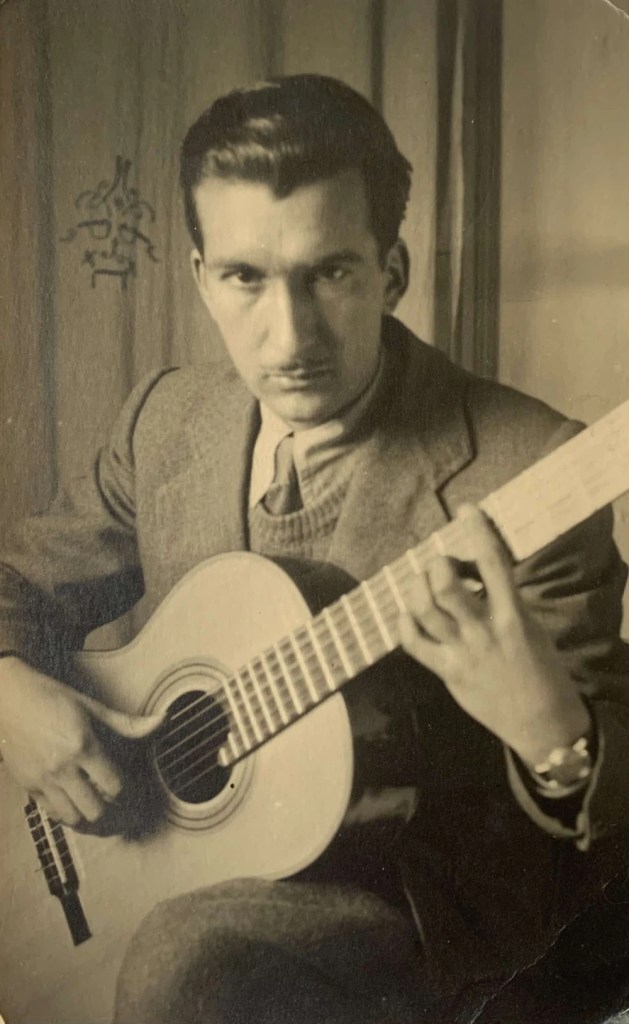
Federico Orsolino began learning guitar at age fourteen, but his studies were interrupted by the Second World War. He was an officer in the Italian Army during the catastrophic invasion of the Soviet Union, in which approximately 80,000 Italian soldiers died. Following the retreat, he was transferred to Verona, but following Italy’s armistice with the Allies in September 1943, he was taken prisoner by the Germans.1
Orsolino would have been presented with a choice: join the Wehrmacht or be sent to the camps. Most went to the camps. Conditions could be brutal for Italian prisoners. Nevertheless, towards the end he somehow managed to obtain a guitar, even giving small concerts in the camp. He resumed his guitar studies after the war, studying under Carlo Palladino, and gave his concert debut in Modena in 1948.2
He was a great advocate of the eptacorde, or seven-string guitar — that is, a normal six string guitar but with an added bass string tuned to B. In the post-war period, there were debates within Italy about the adoption of this instrument, often as part of wider debates about the need to establish a distinctly Italian school of guitar playing. However, the Segovian influence, as with the nail question, was too strong. Asked what he thought of the seven string guitar, Segovia replied: ‘just as one cannot conceive of a five-string violin, I, for my part, cannot conceive of a seven-string guitar. Rather than trying to increase the number of strings, one should try to improve the instrument’s technique.’3
Orsolino responded to Segovia’s statement in a diplomatic two-page article. He noted that it is a mistake to conflate the guitar with the violin, as both the guitar and lute have a rich history of changes in the number and tuning of strings. Orsolino argued that the eptacorde possesses greater polyphonic capacity and is no harder to play; he wrote that he had recently convinced none other than Ida Presti of its merits (not that she took it up). ‘We eptacordisti are fully convinced of the validity of this innovation,’ wrote Orsolino, ‘and we confidently wait for time — sempre galantuomo — to prove us right.’4 Alas, this did not happen — though perhaps, like the French Revolution, it’s too early to tell. Indeed, if I could magically afford to commission a new guitar, I’d be very tempted to ask for a seventh string.
As you will have gathered, as well as being an active performer (sadly there are no recordings), Orsolino penned many articles; he also wrote a method. We therefore have an unusual amount of information about why he played without nails. His reasons seem to be personal, rather than following any other player or school. Indeed, in his Le Prime 48 Lezioni di Chitarra, he expressed his view that the question of nail versus flesh has much to do with individual difference:
The dilemma of fingertips or nails has always been a point of discussion, without arriving at a general conclusion. A specific personal approach needs to be considered; the shape of the hand, the fingers, the fingertips and the quality and type of nails of every guitarist. Also to be considered are the guitarists technical and musical abilities, his mentality and artistic intent.5
He preferred flesh as it is more suited to the ‘classica or melodica’ rather than ‘la musica d’effetto’.6 Like Emilio Pujol, at times he expressed the view that, aesthetically and even psychology, the two ways of playing are fundamentally different.
Finally, his compositions may well deserve renewed attention (unfortunately the scores are not easy to acquire). His four-movement Sonata is a gem. It is a truly modern work, and again goes to show that no-nail playing was not a backwards or nostalgic technique, but one that belongs equally to the twentieth century. Orsolino was a frequent advocate for modern music on the guitar, writing in 1949 that ‘the artist must know how to express his personality and sensitivity, educating the public, rather than becoming its slave.’7
Orsolino’s Sonata has been interpreted wonderfully in a recent recording by Jacopo Figini (who plays with nails, I should add):
- https://www.fondazioneilmc.it/en/post/in-barletta-the-musical-manuscripts-created-in-prison-by-the-guitarist-federico-orsolino ↩︎
- Giovanni Murtula, ‘Federico Orsolino’, in Federico Orsolino, Piccole impressioni di campagna (Musikverlag V. Hladky Wien, 1962) ↩︎
- David Perez, ‘La primae tournée di Segvoai In Israele’, L’arte Chitarristica 6.31 (1952), pp. 6-7 ↩︎
- Federico Orsolino, ‘La Chitarra Eptacorde Continua il Suo Cammino’, L’arte Chitarristica 6.34-35 (1952), pp. 14-15. ↩︎
- Federico Orsolino, Le Prime 48 Lezioni di Chitarra (Edizioni Musicali Farfisa, n.d. [1962]) ↩︎
- Federico Orsolino, La Mano Destra Del Chitarrista (Posizione e Tocco), L’arte Chitarristica 10.59 (1956), pp. 10-12 ↩︎
- Federico Orsolino, A proposito Della Musica Chitarristica Italiana, L’arte Chitarristica 3.17 (1949), pp. 1-2 ↩︎


Leave a comment